
Learn how lenders use AI in credit risk — from default prediction and alternative data to model validation, explainability, governance, and human oversight.
AI has become an important part of credit risk management. It helps lenders analyze more data, identify risk patterns, and monitor portfolios more efficiently.
However, it does not replace the entire credit risk framework. In most cases, AI improves specific stages within an existing process – from default prediction and fraud analysis to portfolio monitoring and model validation.
AI can also help lenders process large amounts of alternative data when traditional credit information is limited.
The value depends on more than predictive performance. Risk teams also need explainability, stable models, reliable data, and strong governance.
In my experience, this distinction matters. The most practical AI projects solve a specific risk problem instead of trying to automate everything at once.
This guide explains where AI fits into credit risk management. It also covers key use cases, models, implementation steps, metrics, governance risks, and human oversight.
AI in credit risk management refers to computational methods that help lenders identify, measure, monitor, or manage credit risk.
The term covers several different technologies. They should not all be treated as the same thing.
Traditional statistical models use defined mathematical relationships between variables. Logistic regression remains a common example in credit risk.
Machine learning models can identify more complex relationships across larger datasets. Decision trees, random forests, and gradient boosting are common examples.
Explainability tools help teams understand model behavior. Techniques such as SHAP can show which variables contributed most to a prediction.
This is closely related to what Explainable AI means, particularly in risk assessment.
Generative AI serves a different purpose for credit organizations. It can summarize documents, extract information, prepare reports, or support analysts working with large amounts of text.
These technologies can all work together.
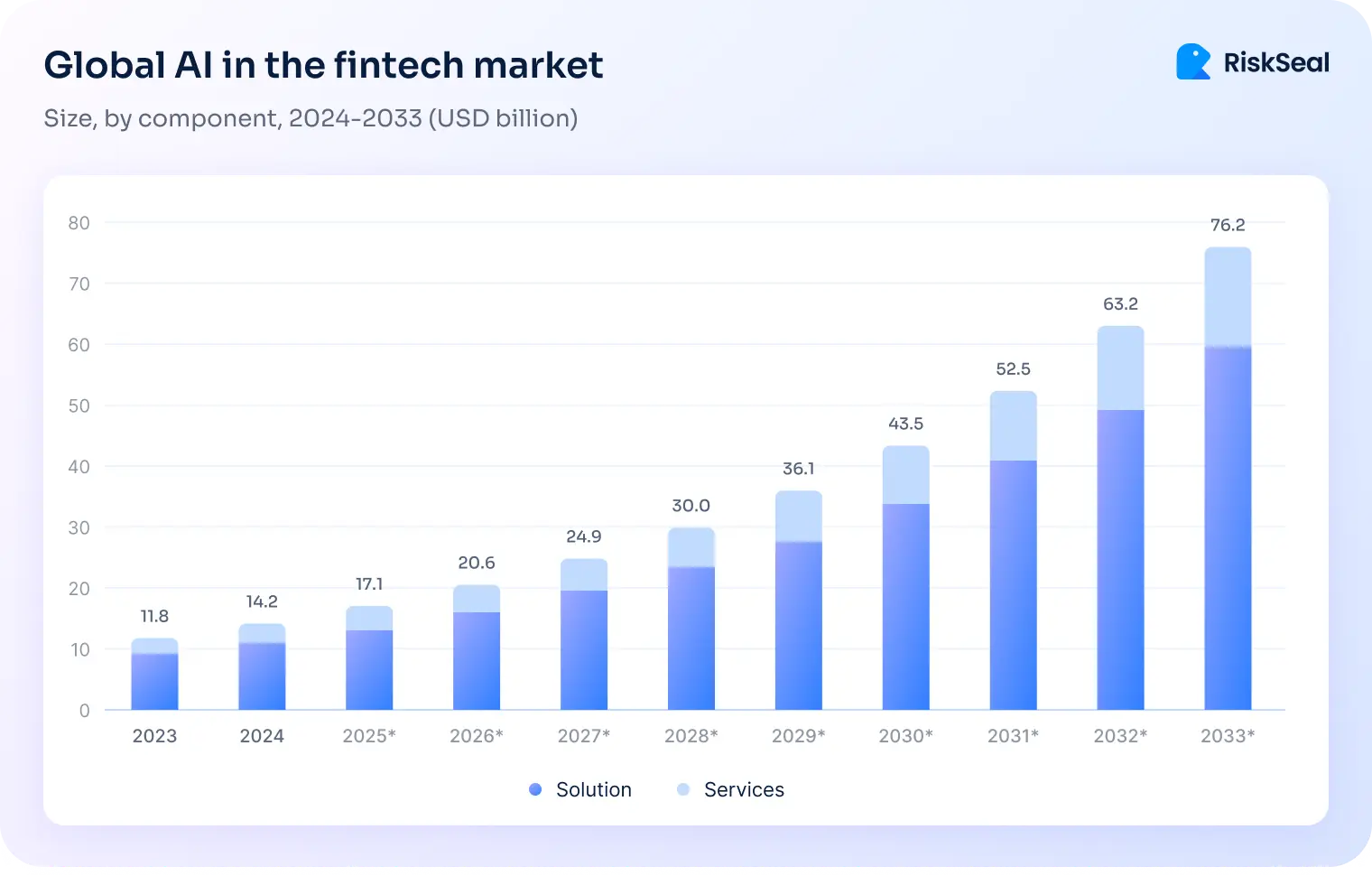
According to statistics, the AI market size in the fintech industry is estimated at $14.2B and is forecast to grow to $76.2B by 2033.
A lender might use gradient boosting for risk prediction. It could then use explainability tools for model review and generative AI for internal reporting.
The right approach depends on the decision being supported. It also depends on data quality, regulation, governance, and operational needs.
AI can support several stages of the credit risk lifecycle. Its role changes depending on the task and available data.
The table below shows a practical division of responsibilities.
The important point is that AI fits into a broader control system.
Credit decisioning is closely related to these processes. Yet using AI for risk analysis does not automatically mean handing the final lending decision to an autonomous model.
For many lenders, the practical architecture remains hybrid. Models provide signals, rules establish boundaries, and people handle defined exceptions.
AI can support many parts of credit risk management. Six applications are especially useful today.
One core use case is estimating the probability that a borrower will default.
Models can use repayment history, utilization, income indicators, transaction patterns, and other permitted variables. Alternative signals can also enrich the dataset.
The lender gets a probability estimate or risk score. That output can feed underwriting, pricing, limit-setting, or portfolio strategies.
Teams should monitor discrimination, calibration, stability, and performance by segment. A strong development result does not guarantee similar production performance.
Practical example: A lender trains a gradient-boosting model using historical loan outcomes. The model identifies combinations of variables associated with higher default rates.
The lender then compares its performance against an existing logistic regression baseline.
Traditional credit information can be limited for some applicants.
Thin-file customers, younger borrowers, gig workers, migrants, and consumers in underbanked markets may have little conventional credit history. That creates an information problem for risk teams.
Alternative data can add another assessment layer.
Depending on legal permissions and the lender's market, signals may include:
Machine learning can help identify useful relationships within these larger datasets.
The goal is not to replace bureau information whenever it exists. Instead, lenders can enrich the information available for specific applicants.
Teams should monitor data quality, stability, predictive contribution, consent, and potential disparate impact.
Practical example: An applicant has almost no bureau history. The lender adds permitted digital and behavioral signals to its existing assessment process.
The additional information helps the risk team distinguish between limited history and elevated risk.
Fraud risk and credit risk are different disciplines. However, they often interact during lending.
An applicant who presents inconsistent identity information creates a different risk profile. The same applies when application behavior shows unusual patterns.
AI can help identify anomalies across identity, device, contact, transaction, or behavioral information.
Models may detect unusual combinations that fixed rules miss. They can also help prioritize cases for additional checks.
The output can become one input within the wider credit assessment process.
Teams should monitor false positives carefully. Aggressive fraud filters can reject legitimate applicants and create unnecessary manual work.
Practical example: A new application contains several internally inconsistent digital signals. An anomaly model flags the case for further verification.
The lender reviews the additional evidence before continuing the process.
Credit risk continues after origination.
Lenders need to detect deterioration before it becomes a serious portfolio problem. AI can help analyze changing borrower and portfolio behavior.
Useful inputs can include repayment patterns, revolving utilization, cash-flow changes, missed payments, and external economic indicators.
Models can identify borrowers or segments showing unusual deterioration.
Risk teams then get prioritized alerts rather than reviewing every account equally.
Monitoring quality matters as much as prediction quality. Teams should track false alerts, missed deterioration, segment performance, and drift.
Practical example: A monitoring model identifies rising utilization and worsening payment behavior in one borrower segment. Risk analysts investigate whether the pattern represents temporary volatility or broader deterioration.
They can then adjust monitoring or intervention strategies.
Fintech and bank teams also need to understand what happens when conditions change.
AI can support traditional stress-testing methods by identifying relationships across larger datasets. Models can examine how portfolio outcomes respond to changing economic variables.
Inputs may include unemployment, inflation, interest rates, borrower characteristics, and historical portfolio performance.
The lender can use these results to explore possible portfolio responses.
However, stress testing still requires human judgment. Future shocks rarely follow historical patterns perfectly.
Teams should review assumptions, nonlinear responses, scenario plausibility, and model sensitivity.
Practical example: A lender tests a scenario with higher unemployment and declining household income. The model estimates how different portfolio segments might respond.
Risk managers review those estimates alongside existing stress-testing methods.
Generative AI creates a different set of opportunities.
It can help analysts process large amounts of written information. Examples include credit memos, policies, financial documents, monitoring reports, or internal model documentation.
A generative system can summarize documents or extract relevant sections. It can also help prepare first drafts of reports.
The final result still requires review.
Generative models can produce inaccurate statements, omit context, or create unsupported conclusions. NIST's Generative AI Profile specifically treats generative AI as a distinct risk-management area requiring dedicated controls.
Practical example: An analyst needs information from dozens of lengthy borrower documents. A generative AI tool extracts relevant sections and prepares a summary.
The analyst verifies the underlying information before using it.
The shift toward AI is sometimes presented as a competition between old and new technology.
That framing misses how modern credit systems actually work.
Traditional statistical models remain valuable because they can be stable, transparent, and relatively easy to validate. AI-based models can add value where larger datasets or complex relationships matter.
The more useful comparison is therefore between different approaches to the same risk problem.
Neither column is automatically superior.
A highly explainable logistic regression model can outperform a poorly designed machine learning system. A more complex algorithm only adds value when its benefits survive validation.
This is also why hybrid approaches are practical.
A lender might use machine learning to generate additional risk indicators. Traditional policy rules can still define hard limits and escalation requirements.
For thin-file assessment, digital footprint data can provide deeper context without replacing existing information. This gives risk teams additional context while preserving established controls.
I have seen this hybrid logic become especially useful when teams face strict governance requirements.
Innovation becomes easier to defend when each new component has a clearly defined role.
A credit risk model depends first on its data.
Algorithms cannot compensate for weak inputs. Poor data can simply produce more sophisticated errors.
Traditional sources may include:
Alternative sources can add signals not captured by traditional files.
Depending on market rules and consent, these can include digital footprints, payment behavior, device signals, phone or email attributes, e-commerce activity, or other behavioral information.
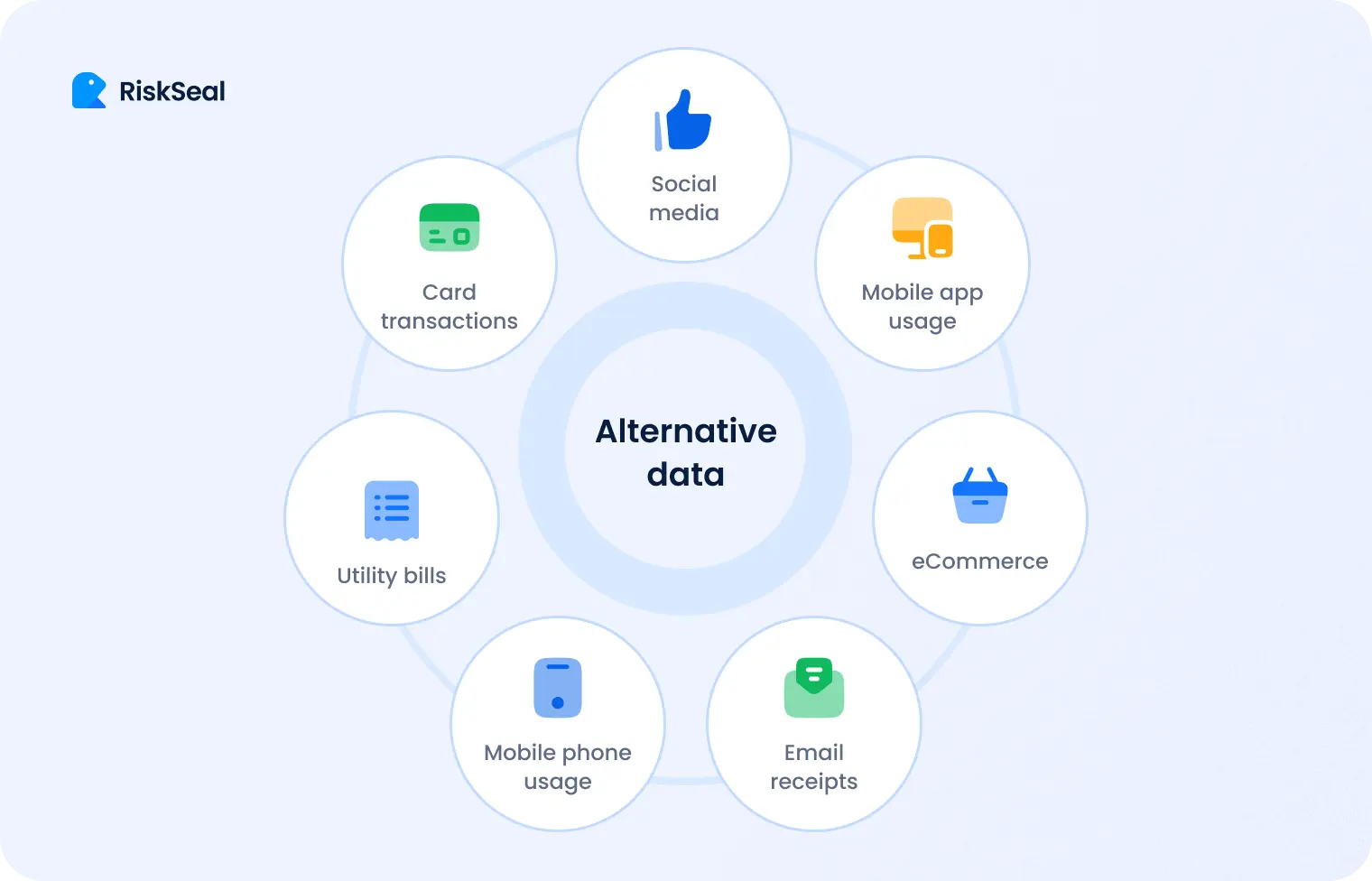
Each data source needs a clear purpose.
Risk teams should understand where it comes from, how often it changes, how reliable it is, and whether its use is legally permitted.
Logistic regression remains an important credit-risk baseline.
It provides a useful reference because teams understand its behavior well. Its outputs are also relatively straightforward to explain and validate.
A stronger machine learning model should demonstrate meaningful improvement against this baseline.
Complexity by itself is not evidence of value.
Decision trees divide observations according to defined feature thresholds.
They are relatively intuitive and can model nonlinear relationships. Individual trees can also be easier to interpret than many complex alternatives.
Their weakness is instability when used alone.
Small changes in training data can produce different tree structures.
Random forests combine many decision trees.
This usually improves stability and predictive performance over a single tree. The model can capture nonlinear relationships and interactions.
Interpretation becomes more complex, however.
Teams therefore need suitable explainability and validation methods.
Gradient-boosted trees are widely useful for structured risk data.
They can perform strongly when relationships between variables are nonlinear. They can also capture interactions without requiring teams to define each one manually.
Their additional complexity increases governance requirements.
Risk teams need to test stability, explainability, calibration, and sensitivity.
Neural networks can make sense when the data genuinely demands them.
Possible applications include complex behavioral sequences, images, text, or very large datasets.
For ordinary tabular credit-risk data, simpler models may remain competitive.
The right question is therefore not whether a neural network is more advanced. It is whether the added complexity produces a measurable and governable advantage.
AUC/ROC measures how well a model separates higher-risk and lower-risk observations.
Gini provides a related measure of discriminatory power. KS also measures separation between score distributions.
These metrics help teams compare models.
Calibration measures whether predicted probabilities match observed outcomes.
A model can rank borrowers correctly while producing inaccurate probability estimates.
The Brier score can help evaluate probabilistic accuracy.
Calibration plots also show how predicted risk compares with actual outcomes across groups.
Production data changes.
Borrower behavior can shift, acquisition channels can change, and economic conditions can alter default patterns.
Population Stability Index, or PSI, is one common monitoring metric.
Teams can also monitor feature distributions, score distributions, missingness, and outcome relationships.
No single drift metric provides a complete answer.
A threshold breach should trigger investigation rather than an automatic conclusion.
Technical accuracy must connect to portfolio performance.
Relevant metrics can include:
A high AUC does not prove business value.
It also does not prove fairness, stability, or appropriate calibration. Those questions require separate testing.
AI implementation works best when teams start from the business problem. The following process creates clearer ownership and better validation.
Start with one specific use case.
The goal might be improving thin-file assessment, predicting delinquency, reducing manual review, or identifying early portfolio deterioration.
Define how the model will influence the process. Also establish acceptable risk levels and escalation rules.
Deliverable: business-use-case document and risk-appetite definition.
Create an inventory of every planned data source.
Record ownership, coverage, history, quality, consent requirements, permitted uses, and data lineage. Check missingness and stability.
Also verify whether production data will match development data.
Deliverable: data inventory and lineage documentation.
Build or document a simple benchmark. For many credit-risk problems, logistic regression provides a useful baseline.
Measure its performance using the same validation framework planned for more complex models. This creates an objective comparison.
Deliverable: baseline model and benchmark report.
Develop candidate models using appropriate development samples. Keep genuinely future or out-of-time observations for validation.
Compare discrimination and calibration. Also test stability across customer groups, products, and acquisition channels.
Deliverable: model-development and validation report.
Evaluate how the model behaves beyond aggregate performance. Review important features and individual predictions. Test unusual applications and sparse-data cases.
Evaluate relevant fairness metrics. Also examine whether any features operate as inappropriate proxies.
Deliverable: explainability and fairness assessment.
Every production model needs an accountable owner. Document its purpose, data, methodology, intended users, limitations, validation results, and monitoring requirements.
A model card can provide a practical summary. More detailed documentation should support validation and audit work.
Deliverable: model card, governance record, and assigned model owner.
Start with controlled exposure. Define which outputs can flow through existing processes. Specify which cases require manual review.
Set thresholds before the pilot begins. Otherwise, teams may change credit decisioning workflows and rules in response to short-term results.
Deliverable: pilot protocol and approval or review thresholds.
Deployment starts a new stage of model risk management.
Track discrimination, calibration, drift, approval outcomes, default rates, and manual reviews.
Monitor segments separately when necessary. Aggregate portfolio metrics can hide local problems.
Deliverable: production monitoring dashboard.
Decide what happens when performance changes. Create thresholds for investigation, retraining, model restriction, and rollback.
Document who can approve each action. This prevents improvised responses when a model deteriorates.
Deliverable: retraining policy, escalation workflow, and rollback plan.
AI gives risk teams more analytical options. It also creates additional control requirements.
The goal of governance is not to prevent innovation. It is to make the technology reliable enough for high-consequence decisions.
Models learn from the information available during development. If that information does not represent future applicants, performance can deteriorate.
Historical data may also reflect previous product rules or selection effects. Teams need to understand how the dataset was created.
Model performance can vary across groups. Bias can enter through data, labels, feature selection, historical decisions, or deployment conditions.
Removing obvious protected variables alone does not solve the problem. Other variables may contain correlated information.
Risk teams need to understand what drives model outputs. This matters for internal validation, consumer explanations, audit processes, and regulatory review.
Complex models can require additional explanation techniques.
The European Banking Authority has made it clear that machine learning can be used within the IRB framework. The focus is on using these models carefully and meeting the required risk, governance, and regulatory standards.
A model can perform extremely well during development and fail later. Overfitting happens when a model learns patterns that do not generalize.
Data leakage creates an even more misleading result. It happens when development data contains information that would not actually be available at prediction time.
Out-of-time validation helps uncover both problems.
Relationships change after deployment. Economic conditions, customer behavior, product design, and marketing channels can all shift.
Risk teams therefore need continuous monitoring. Retraining should follow controlled procedures rather than happening automatically whenever drift appears.
More data does not automatically mean better risk management. Each input needs a legitimate purpose and appropriate controls.
This becomes especially important with alternative data.
Teams need to consider data minimization, consent, retention, access, and relevant privacy requirements.
Many AI systems depend on external providers.
A lender may use third parties for data, model infrastructure, identity signals, or analytics. That creates dependency risk.
Teams need to understand data provenance, service limitations, monitoring arrangements, and change-management procedures.
People can over-trust model outputs. This becomes dangerous when a score appears precise but depends on weak or unusual data.
Human review therefore needs a clear purpose.
Analysts should have enough information to challenge the model rather than simply approve its recommendation.
Generative AI introduces another category of risk.
A language model can produce plausible but incorrect information. It can also summarize a document inaccurately or omit an important qualification.
NIST's AI RMF is designed to help organizations incorporate trustworthiness into AI design, development, use, and evaluation.
NIST also maintains a separate Generative AI Profile for risks specific to generative systems.
For credit-risk teams, that supports a simple principle. Generated content should remain verifiable whenever it contributes to a material risk process.
Human oversight should be designed into the workflow. That includes identifying who approves models, who reviews exceptions, and who can stop or modify a system.
The human role also needs clear information. A reviewer cannot provide meaningful oversight without access to relevant evidence and explanations.
Regulatory frameworks increasingly focus on risk management, transparency, validation, and accountability.
In the EU, the AI Act classifies AI systems used to evaluate the creditworthiness or credit score of natural persons as high-risk systems, subject to the Act's scope and specific exceptions.
The regulation separately notes exceptions involving certain fraud-detection and prudential applications.
In the United States, the Federal Reserve, OCC, and FDIC issued revised model-risk guidance in April 2026. Federal Reserve SR 26-2 replaced SR 11-7 and emphasizes model-risk practices tailored to a banking organization's risk profile, size, complexity, and model use.
These frameworks differ in scope and legal status. Their shared practical message is still useful: lenders need strong validation, governance, transparency, data controls, and risk ownership.
AI-based credit risk assessment depends heavily on useful data.
This becomes challenging when a traditional credit file provides limited information.
RiskSeal provides alternative data and digital risk signals that lenders can add to existing risk processes. These signals enrich scoring and risk models rather than replace the lender's existing infrastructure.

This API-based scoring approach can be particularly useful for thin-file and credit-invisible applicants.
Digital information provides another assessment layer when conventional credit history alone offers limited insight.
RiskSeal can also provide signals relevant to fraud and identity consistency. Those indicators can help risk teams investigate inconsistencies that may affect the wider assessment.
The final credit decision remains with the lender and its decision framework.
That separation is important because alternative data works best as part of a controlled, explainable risk process rather than as an isolated answer to every underwriting problem.
In my experience, the strongest alternative-data projects start with a measurable information gap.
Teams can then test whether the new signals add predictive or operational value before expanding their use.
AI can improve several parts of credit risk management.
It can support prediction, alternative-data analysis, fraud detection, portfolio monitoring, stress testing, and analyst workflows.
The model itself is only one part of the system.
Data quality, calibration, explainability, validation, monitoring, governance, and human oversight determine whether the technology works safely in production.
More complexity does not automatically create more value. A stable and explainable AI model that improves portfolio outcomes can be more useful than a sophisticated model that is difficult to control.
For lenders exploring AI, a focused pilot is often the best starting point.
Choose a specific problem, define measurable outcomes, establish a baseline, and test whether AI creates enough additional value to justify its complexity.
How is AI used in risk management?

AI in credit risk management is indispensable in optimizing traditional credit scoring models. This technology allows you to select variables that affect credit risk and adjust the parameters of the credit risk model.
AI is also used for risk assessment, decision automation, and dynamic credit risk monitoring.
How do traditional credit risk models differ from AI-based models?
Traditional credit risk models rely on static historical data that may no longer be relevant at the time a loan application is processed. In addition, they are limited to financial information, which discourages lending to unbanked people.
AI-based models allow the use of alternative data that is updated in real-time. This helps to objectively assess the borrower and lend to people with no credit history.
What are the main risks of using AI in credit risk management?
Key risks include poor data, bias, limited explainability, overfitting, data leakage, model drift, privacy issues, vendor risk, and automation bias.
Generative AI also introduces risks such as hallucinated or unsupported information.
Which AI models are used for credit risk assessment?
Common approaches include logistic regression, decision trees, random forests, and gradient-boosting models.
Neural networks can be useful for specific complex data types, but their additional complexity should have a clear business and modeling justification.
The right model depends on the data and task.
Explainability, validation requirements, calibration, stability, and business impact also influence the choice.
How does RiskSeal support AI-enabled credit risk assessment?
RiskSeal provides alternative data and digital risk signals that can enrich existing scoring and risk models.
This can help lenders assess thin-file and credit-invisible applicants while adding fraud and identity-consistency information to their existing risk processes.
RiskSeal does not need to replace a lender's decision infrastructure to provide value.
Its data can serve as an extra source of information within the lender's existing credit risk framework.

Examine how to integrate location insights into your credit scoring models to reduce default rates and gain a competitive advantage.


Learn how IP address analysis can enhance borrower creditworthiness assessments.
.webp)
Dive into explainable AI in credit scoring to boost transparency, reduce bias, build trust, and ensure full regulatory compliance.