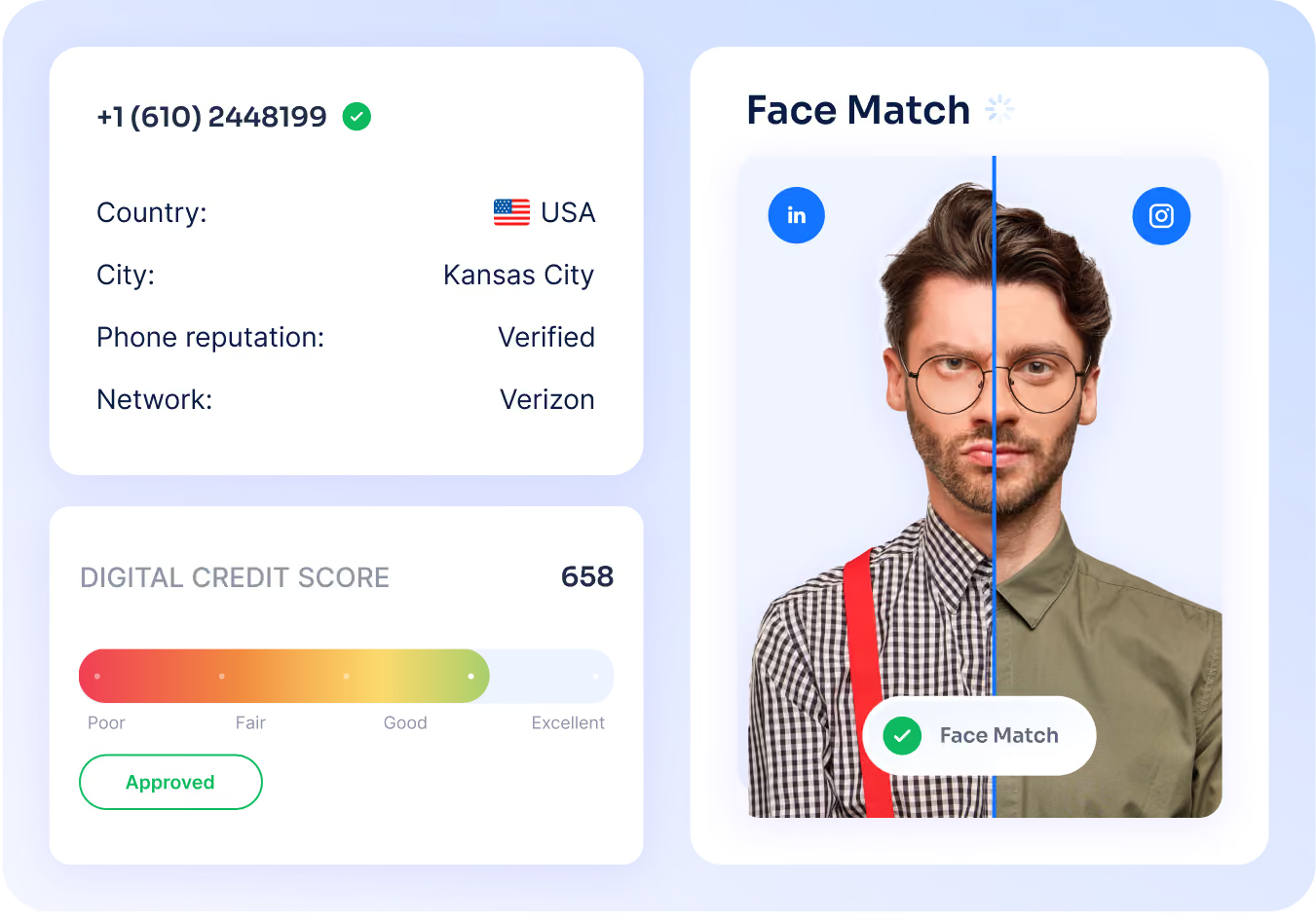
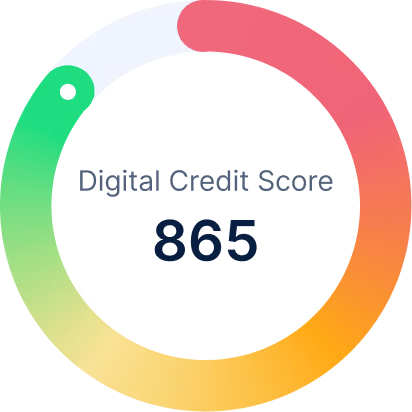
a Través de la Huella Digital

Proveedor de datos alternativos
para riesgo crediticio

Análisis de huella digital en más de 200 plataformas globales y regionales.

Más de 400 datos en tiempo real analizados por solicitante.

Puntaje Crediticio Digital listo para usar para decisiones inmediatas.

Reserva una demo
Reserva una demo
De confianza por los proveedores fintech más progresistas del mundo

Aumente su tasa de aprobación x2 con la plataforma Digital Credit Scoring

RiskSeal busca correos electrónicos y números de teléfono en tiempo real a través de más de 200 plataformas globales y regionales. Ofrecemos más de 400 puntos de datos y un Puntaje de Crédito Digital listo para usar.

x2

aumento de la tasa
de aprobación

Hasta el 25%

disminución de la tasa de incumplimiento

98%

cobertura de la población desatendida

5 segundos

para un puntaje sin interrupciones en tiempo real

Análisis de la huella digital
para elaborar perfiles de usuario
en más de 200 plataformas

RiskSeal convierte la huella digital de un usuario en más de 400 puntos de datos por solicitante de préstamo, creando un perfil claro para tomar mejores decisiones de crédito y de fraude.

Los proveedores fintech utilizan RiskSeal para enriquecer sus modelos de riesgo y tomar mejores decisiones de aprobación en casos donde las agencias de crédito son débiles o tienen información incompleta.

Digital footprint analysis for user

Medios sociales y mensajeros

WhatsApp logo

WhatsApp

LinkedIn logo

LinkedIn

Instagram logo

Instagram

+45

Comercio electrónico

Amazon logo

Amazon

ebay logo

eBay

Walmart logo

Walmart

+30

Suscripciones pagadas

Netflix logo

Netflix

Disney logo

Disney+

Spotify logo

Spotify

+15

Recursos de la web

Apple logo

Apple

Google logo

Google

ZOHO logo

Zoho

+60

Análisis de huella digital
platform

y puntaje de crédito

Análisis dela huella digital

Descubre las actividades sospechosas en línea y los hábitos financieros con una profunda inmersión en el comportamiento digital del prestatario.

140+ plataformas disponibles
Plataformas de juegos de azar y apuestas
Suscripción de pago
Digital footprint analysis

Puntaje de crédito digital y métricas clave
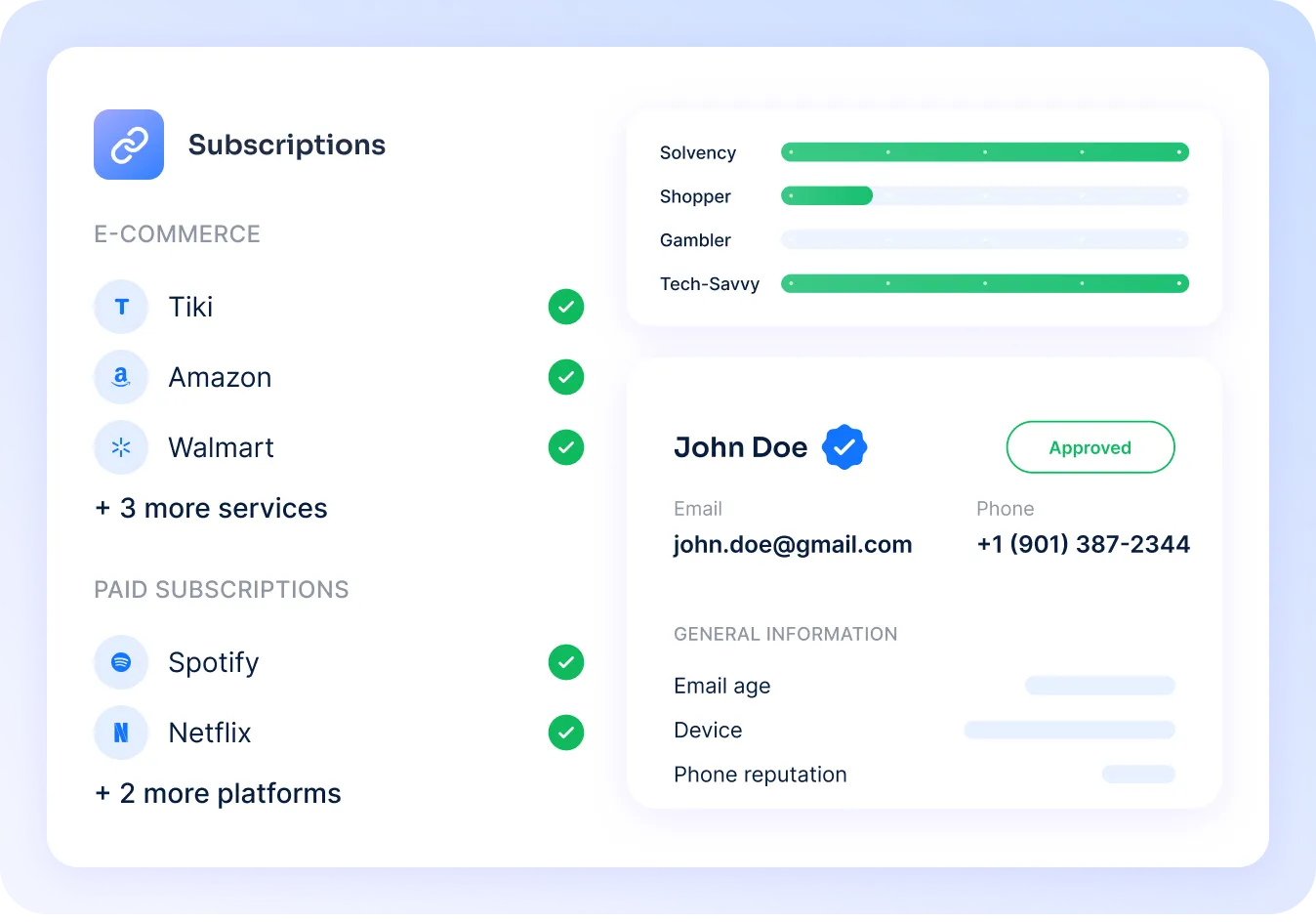
Obtenga un perfil detallado del cliente y un Puntaje de Crédito Digital lista para usar con solo una llamada a la API.

Puntaje de confianza en tiempo real
Hábitos de comercio electrónicoy poder de compra
Puntaje de solvencia
Comportamiento financiero
Digital Credit Score and key metrics

Búsqueda por correo electrónico

Descubre múltiples puntos de datos sobre cada posible prestatario - suscripciones pagadas, medios sociales, registro en línea, avatares y más.

Perfiles digitales y sociales
Registros de las páginas web
Verificación de la entregabilidad
Análisis de dominio
Violaciones de datos
Comprobación de la fecha de creación
Email lookup

Búsqueda de número de teléfono

Reciba información sobre los perfiles de los clientes en las redes sociales y los mensajeros, avatares, información de las empresas de telecomunicaciones, etc.

Números no válidos
Números desechables
SIM virtuales
Teléfonos desechables
Falta de cuentas digitales y sociales
Asociación con actividades de alto riesgo
Phone number lookup

Búsqueda de IP

Analice las redes de los clientes y revele configuraciones sospechosas identificandosu ubicación, el uso de anonimizadoresy el tipo de IP.

Datos de geolocalización
Uso de VPN o proxy
Conexión a través de TOR
Controles de la base de datos de listas negras
Verificaciones de IP móvil y residencial
Centro de datos IPs
IP lookup

Enriquecimiento de datos

Convierta los datos de los clientes en más de 400 puntos de datos y reciba ayuda automatizada para la toma de decisiones.

Datos de correo electrónico y número de teléfono
Reconocimiento facial
Información sobre la ubicación
Coincidencia de nombres
Data Enrichment

Estudio de caso

El Impacto de los
Digital Credit Scores de las Tasas de Impago de Préstamos

En este estudio de caso, compartimos los resultados de la colaboración entre RiskSeal y una destacada entidad de préstamos en México.

Descargar
Descargar
The Impact of Digital Credit Scores on Loan Default Rates

Descubra por qué los principales proveedores fintech confían
en RiskSeal

Decisiones crediticias basadas en el comportamiento

Trabajar con RiskSeal supuso un punto de inflexión para nuestra estrategia de crecimiento. El análisis de la huella digital de RiskSeal nos permitió conocer en profundidad el comportamiento financiero de los solicitantes. Ahora podemos aprobar más préstamos con confianza, reducir el fraude y aumentar nuestra base de clientes, todo ello sin aumentar el riesgo.

Tamara Horev-Chuianova
CEO at Clicredito MX
Read Case Study
Arrow right blue
Incorporación más inteligente, mejores resultados

Los datos en tiempo real de RiskSeal han transformado nuestro proceso de incorporación de clientes. Al detectar el fraude desde el principio y mejorar nuestras capacidades de evaluación crediticia, hemos observado un impacto positivo significativo en las tasas de conversión.


Artjoms Jefimovs
Artjoms Jefimovs
Director de Riesgos @AvaFin
Read Case Study
Arrow right blue
RiskSeal ha impulsado nuestras decisiones de crédito

RiskSeal crea un perfil en línea detallado para cada solicitante, que cubre sus actividades en las redes sociales y en línea. También proporcionan Puntajes de Crédito Digitales altamente precisos. Esta información nos permite tomar decisiones de crédito bien informadas.

Yevhen Krykun
Yevhen Krykun
Jefe de Ciencia de Datos @OnCredit
Read Case Study
Arrow right blue

Descubra nuestras regiones

RiskSeal proporciona datos alternativos a las instituciones financieras de 145 países.
Explore las principales regiones en las que operamos.

Descubra nuestras regiones

RiskSeal proporciona datos alternativos a las instituciones financieras de 145 países.
Explore las principales regiones en las que operamos.

Flag of Spain
España
Flag of Argentina
Argentina
Flag of Chilie
Chile
Flag of Uruguay
Uruguay
Flag of Brazil
Brasil
Flag of United States of America
Estados Unidos
Guatemala
Paraguay

Por qué RiskSeal

Rentable

Prueba de concepto gratuita
Modelo de pago por uso
Sin cargos adicionales
Infraestructura escalable
Cost-effective

Rápido

5 segundos para identificar
a futuros incumplidores
ROI inmediato
8 horas en promedio para integrar
con un API Endpoint

Legal

GDPR y cumplimiento de las normas del sector
Medidas de protección de datos seguras y robustas

Fácil de usar

Listo para usar
Portal intuitivo para clientes
Región específica 
API fácil para
desarrolladores
User-friendly dashboard

RiskSeal es reconocido
en toda la industria fintech

Capterra awardsSoftware Advice awardsGetApp awards

FAQ

What is alternative data?

Alternative data refers to non-traditional data sources used by lenders and alternative data providers like RiskSeal to support credit risk assessment and fraud detection. Especially when credit bureau data is limited, outdated, or unavailable.

It is commonly applied in credit scoring and underwriting decisions where traditional models fail to accurately assess risk.

In lending, alternative data is typically analyzed as structured signal groups rather than raw attributes. These include:
-Digital identity signals, such as email and phone reputation
-Online presence and stability indicators, including account longevity and consistency across platforms
-Behavioral and network signals, such as usage patterns and anomaly detection
-Technical and location signals, including IP intelligence, device fingerprints, and geo-consistency

Together, these elements form an applicant’s digital footprint, which can be evaluated by risk models to detect both creditworthiness and fraud risk.

Unlike credit bureau data, which is based primarily on historical borrowing and repayment behavior, alternative data complements rather than replaces traditional credit reports.

Its value emerges precisely where credit bureaus are weakest: early in the customer lifecycle, in new or fragmented credit markets such as Latin America, parts of Southeast Asia, and Africa, or in segments with limited formal credit history.

Risk and data science teams use alternative data in scoring models, validate it through backtesting, and measure its impact on portfolio metrics such as default rates and fraud losses.

Alternative data is especially valuable for assessing thin-file and no-file borrowers, including first-time borrowers, informal workers, and underbanked populations.

For online lenders, MFIs, and digital-first financial institutions operating in emerging markets, alternative data enables safer credit decisions, higher approval rates, and improved risk control without lowering underwriting standards.

How to use alternative data?

In lending, alternative data is used as an enrichment layer within the credit underwriting process, embedded directly into the decision flow and applied alongside credit bureau data, not as a replacement.

Its role is to provide additional risk insights in cases where bureau information is incomplete, delayed, or not predictive enough for reliable decision-making.

Operationally, alternative data is integrated into underwriting systems via API-based, real-time decisioning provided by an alternative data company like RiskSeal.

During an application, lenders submit basic identifiers – such as an email address, phone number, or IP address – which are evaluated within seconds.

The output is not raw data, but structured risk signals, scores, and flags that can be consumed by risk teams and data science models without adding friction to the borrower journey.

These signals are actively used in underwriting, not just observed.

Lenders incorporate alternative data as additional features in scoring models, apply it within decision rules, or use it to adjust approval thresholds – particularly for thin-file and no-file applicants.

The data is also backtested and monitored to ensure it contributes positively to portfolio-level metrics.

From a risk perspective, this approach enables teams to:
-Improve decision confidence when credit bureau data is limited or inconclusive
-Segment thin-file and first-time borrowers more accurately within existing risk models
-Detect potential credit and fraud risk earlier without introducing extra user friction
-Expand approvals in a controlled way while maintaining stable portfolio performance

RiskSeal follows this exact model of use. Our alternative credit scoring company operates as an API-based alternative data enrichment layer, delivering real-time risk insights from applicants’ digital footprints.

These integrate seamlessly into existing underwriting workflows, decision engines, and scoring frameworks.

How does RiskSeal use alternative data for credit scoring?

RiskSeal generates a Digital Credit Score – an alternative data-based, country-specific risk score designed to be used as an enrichment layer in credit underwriting.

It does not replace traditional scoring systems. Instead, it provides additional risk insight in cases where bureau data alone is insufficient.

The score is produced by a proprietary, country-specific model trained on insights from over 100 million loan applications.

While the modeling approach is proprietary, its risk logic is explicit.

Real-time alternative data signals are translated into risk patterns that reflect the depth, consistency, and stability of an applicant’s digital footprint, which have been shown to correlate with credit and fraud risk at the local market level.

Rather than treating signals as a flat feature list, our alternative credit scoring company evaluates them through risk-relevant groups commonly used by risk teams and data scientists:
-Identity stability signals, such as email and phone reputation, account age, and SIM consistency
-Network and device consistency, including IP, device, location, and timezone alignment
-Behavioral and economic proxies, such as subscriptions, eCommerce activity, and web registrations
-Risk and anomaly markers, including breach exposure and known fraud indicators

Each applicant receives a score from 0 to 999, where higher values indicate lower estimated risk.

In underwriting, this score can be used as an additional feature in scoring models, applied within decision rules, or used to set or adjust approval thresholds. Always in combination with credit bureau data and internal policies, not as a single deciding factor.

Transparency and auditability are core to how the score is delivered. All scoring inputs are explainable, with raw signals and underlying attributes available via API.

This makes the model suitable for backtesting, model validation, internal audits, and regulatory review, including EU-regulated environments.

RiskSeal allows risk teams to understand, test, and control how alternative data contributes to their underwriting decisions.

How does RiskSeal increase approval rates without increasing risk?

RiskSeal increases approval rates by recovering creditworthy applicants who are systematically misclassified or left unscored by traditional credit bureaus, rather than by expanding approvals into higher-risk segments.

The additional approvals primarily come from thin-file and no-file applicants whose real-world financial behavior is not visible in bureau data.

The risk profile does not deteriorate because RiskSeal does not rely on a single “better score,” but on finer segmentation within the same risk appetite.

By analyzing behavioral depth, stability, and consistency signals from an applicant’s digital footprint, alternative data scoring adds granularity within segments that bureaus treat as homogeneous.

High-risk applicants remain high risk, while previously indistinguishable applicants can be separated into more accurate risk bands based on signal quality, not signal volume.

In underwriting, RiskSeal is used alongside traditional credit bureau data and internal scoring models. Its alternative data score and risk signals are applied as enrichment features, decision rules, or threshold adjustments.

This allows risk teams to approve more applicants within existing policies, without weakening controls or changing core model assumptions.

In practice, lenders typically observe higher approval rates within thin-file segments, while portfolio-level risk metrics – such as default and recovery rates – remain stable or improve.

RiskSeal clients typically achieve a 2x increase in approval rates. At the same time, we help simultaneously reduce default rates by up to 25%.

These outcomes are validated through pilots, backtesting, and ongoing monitoring, ensuring that growth comes from better classification, not increased risk tolerance.

How accurate is RiskSeal when scoring unbanked and underserved borrowers?

When evaluating unbanked and underserved borrowers, it is important to distinguish coverage from accuracy – and RiskSeal addresses both explicitly.

Coverage refers to the ability to generate usable risk signals when credit bureau data is unavailable, incomplete, or fragmented.

RiskSeal is able to derive alternative data signals for the vast majority of thin-file and no-file applicants by analyzing their digital footprint data, allowing lenders to assess applicants who would otherwise remain unscorable using traditional methods.

In this sense, RiskSeal helps lenders see more applicants, not assume they are all low risk.

Accuracy, in contrast, refers to risk differentiation – the ability to meaningfully separate higher-risk from lower-risk borrowers within underserved segments.

RiskSeal’s alternative credit scoring focuses on identifying statistically significant patterns of stability, consistency, and participation in the digital economy, which have predictive value even in the absence of formal credit history.

These patterns are especially relevant for first-time borrowers, recent immigrants, young adults, informal workers, and other underbanked groups, where traditional bureau signals provide limited insight.

RiskSeal’s performance is evaluated through backtesting and real-world portfolio analysis, with results assessed at the segment and cohort level, particularly for thin-file populations.

Lenders using RiskSeal typically observe improved risk segmentation within these groups, reflected in stable or improved default metrics when alternative data signals are used as an enrichment layer alongside existing underwriting models, rather than as a replacement for credit bureaus.

In practice, RiskSeal does not aim to “predict outcomes with certainty” for every individual.

Instead, it provides actionable risk signals that enable more accurate underwriting decisions for underserved borrowers, supported by empirical testing and ongoing performance monitoring in live lending environments.

How does RiskSeal validate accuracy and performance for underserved segments?

RiskSeal validates accuracy and performance for underserved segments through a combination of data science validation, backtesting, and live portfolio monitoring, with a clear focus on thin-file and no-file cohorts rather than aggregate averages.

The objective is not to “prove the score is right for everyone,” but to demonstrate reliable risk differentiation where traditional credit bureau data is weak or unavailable.

Validation begins with offline backtesting on historical loan data, where alternative data signals and scores are evaluated against observed repayment and default outcomes within underserved segments.

Risk teams assess whether the signals provide statistically significant separation between risk bands, using standard credit risk metrics and cohort-level analysis.

This step ensures that alternative data adds measurable predictive value beyond bureau-based models, rather than duplicating or distorting existing signals.

RiskSeal then validates performance in controlled pilots and phased rollouts. During these periods, the alternative data score is used as an enrichment feature. For example, in parallel decision rules or shadow scoring.

It allows lenders to compare outcomes between approved populations with and without alternative data influence.

This approach enables direct measurement of impact on approval distribution, default behavior, and early risk indicators without changing overall risk appetite.

Once live, performance is monitored through ongoing portfolio analysis, with regular reviews of key risk metrics at the segment level.

Lenders track how underserved borrowers scored by RiskSeal perform over time, ensuring that observed outcomes remain consistent with expectations and that the model continues to behave as intended under changing market conditions.

Throughout this process, transparency and auditability are maintained. RiskSeal provides explainable inputs, raw signals, and score components via API, supporting internal model validation, documentation, and regulatory review.

This allows risk and compliance teams to independently test assumptions, confirm stability, and maintain control over how alternative data is used in underwriting for underserved populations.

What types of alternative data does RiskSeal offer?

RiskSeal is an alternative data provider for credit risk and fraud decisioning.

Rather than collecting raw data points in isolation, the credit risk platform delivers structured alternative data signals derived from digital footprint analysis, grouped around core risk dimensions that are relevant for underwriting and identity assessment.

These signals are designed to complement credit bureau data and support explainable, real-time credit decisions.

The main categories of alternative data used by RiskSeal include:
-Network and access signals. IP- and network-based indicators are used to assess both risk and consistency. In addition to identifying anomalous or high-risk access patterns, these signals help confirm expected location behavior, routing stability, and repeat access patterns, which are relevant for both fraud prevention and credit risk assessment.

-Digital commerce activity. Engagement with major online marketplaces reflects account longevity, continuity, and participation in the formal digital economy. The analysis focuses on the presence and age of accounts and sustained usage over time, rather than on specific purchases or spending details.

-Subscription behavior. Recurring subscription relationships are evaluated as indicators of predictability and payment continuity. RiskSeal analyzes the existence and regularity of ongoing services, not their content or discretionary value, to understand stability in recurring financial behavior.

-Email footprint analysis. Email signals are a core component of RiskSeal’s identity assessment. Factors such as address validity, domain reputation, account age, long-term usage patterns, breach exposure, and linkage across established platforms help evaluate identity durability and distinguish stable digital identities from newly created or low-trust ones.

-Phone number intelligence. Phone-related signals are structured around number validity, age, carrier consistency, and reuse across trusted services. These indicators help confirm whether a mobile number represents a durable, actively used point of contact rather than a temporary or high-risk identifier.

-Social identity signals. RiskSeal relies only on public-facing presence indicators, focusing on continuity and coherence across platforms rather than on content or social behavior. These signals help assess digital maturity and identity consistency without introducing social scoring or content analysis.

All signals are derived from analysis across 200+ global and regional platforms, producing 400+ real-time alternative data signals per applicant.

Delivered via API, these signals are structured for underwriting and credit risk workflows, providing depth, consistency, and explainability rather than isolated data points.

What data sources are included in RiskSeal’s digital footprint analysis?

RiskSeal is an alternative data and credit risk platform that combines a defined set of alternative data sources commonly used in credit and fraud decisioning. These sources are selected specifically to assess identity stability, behavioral consistency, and digital presence in real time, and are structured for use in underwriting and credit risk decisions, not for broad data collection.

The digital footprint analysis draws from the following classes of sources, each mapped to a clear risk purpose:
-Social and professional platforms. RiskSeal uses publicly available presence signals only, focusing on account existence, continuity, and longevity across platforms such as LinkedIn, Facebook, Instagram, and similar services. The goal is to assess digital maturity and identity persistence, not social behavior or content.

-Public profile identity elements. Signals derived from usernames and other reusable profile attributes are evaluated for consistency and reuse across platforms. This helps assess whether an identity appears stable and coherent over time, without biometric processing or content analysis.

-E-commerce and online marketplaces. Presence on major global and regional marketplaces provides signals related to real-life behavior. RiskSeal does not analyze transactional details or specific purchases. The focus is on durable engagement in the formal digital economy.

-Digital services and subscription platforms. Ongoing relationships with paid digital services are assessed as indicators of recurring behavior and predictability. The analysis considers the existence and continuity of subscriptions, rather than service content.

-Communication and messaging platforms. Signals from email providers and messaging applications are used to confirm the existence, activity, and consistent use of contact points. RiskSeal does not read messages or analyze communication content; only presence and validity signals are used.

-Email and phone verification databases. Specialized sources provide data on identifier validity, age, reuse across services, domain or carrier characteristics, and resistance to disposable identifiers. These signals are central to assessing identity durability and reducing reliance on easily replaceable contact details.

-Network and location data sources. IP and network intelligence is used to evaluate alignment and consistency between declared information and real-time access patterns. In addition to identifying anomalies, these signals help confirm expected, repeatable behavior relevant to both fraud and credit risk.

Across these categories, RiskSeal analyzes signals from 200+ global and regional platforms to generate real-time alternative data inputs via API.

Sources are selected for signal quality, consistency, and explainability, allowing risk teams to understand, validate, and audit how digital footprint signals contribute to credit risk decisioning and underwriting models.

Does RiskSeal replace traditional credit bureaus or complement them?

RiskSeal is designed to complement traditional credit bureaus by default, acting as an alternative data enrichment layer that adds new, non-overlapping information to existing underwriting models.

Its primary role is to enhance credit risk assessment by incorporating behavioral and digital signals that are not captured by bureau data.

In specific and well-defined scenarios – such as thin-file or no-file borrowers, or in markets where credit bureau data is unavailable, fragmented, or unreliable – RiskSeal can be used as a standalone scoring input.

This is a controlled use case, typically applied to underserved segments where traditional bureaus provide limited decision value, rather than a universal replacement for bureau-based scoring.

Model performance has been evaluated through internal and client backtesting, with results varying by market, segment, and use case.

In these tests, RiskSeal’s digital-only alternative data score has demonstrated the ability to meaningfully differentiate risk on its own (illustrative AUC values around 0.67 in thin-file contexts).

When combined with credit bureau data, overall model performance improves further (illustrative combined AUC values around 0.73), indicating that RiskSeal’s signals contribute additional, low-correlated information rather than duplicating existing bureau variables.

This uplift is driven by the fact that digital and behavioral signals capture different dimensions of risk – such as identity stability, consistency, and real-world digital engagement – providing context that traditional credit histories alone cannot offer.

The value lies less in the absolute performance of any single score and more in the incremental improvement achieved through combination.

In practice, lenders apply RiskSeal differently across their portfolios.

For applicants with established credit histories, RiskSeal supports maximum accuracy when used alongside bureau data and internal models.

For thin-file and no-file segments, it may serve as the primary or leading scoring layer, still governed by defined thresholds, decision rules, and risk controls.

This flexibility allows risk teams to deploy RiskSeal in line with their risk appetite, portfolio strategy, and segmentation approach.

It reinforces credit bureau data where it is strong and extends decision coverage where it is weak, without compromising governance or model control.

What inputs are required to run a RiskSeal check?

RiskSeal is designed to operate with a very low input threshold, making it easy to embed into existing underwriting flows without increasing borrower friction. The minimum inputs required to run a RiskSeal check are an applicant’s email address, phone number, and IP address.

Even with this limited set of identifiers, RiskSeal can generate meaningful alternative data risk signals that support credit and fraud assessment as an enrichment layer, not as a standalone KYC or identity verification process.

Additional inputs, such as full name or address, are optional and can be provided at the discretion of the risk team, depending on the market, regulatory context, or specific underwriting setup.

These fields are not required to run the assessment and are used only to enhance signal depth where appropriate, helping lenders avoid unnecessary collection of additional PII while maintaining regulatory flexibility.

RiskSeal is delivered via a real-time API that processes inputs and returns a digital credit score along with structured risk insights within a few seconds.

This latency is aligned with real-time decisioning requirements and allows RiskSeal to fit naturally into existing applications and underwriting workflows.

Importantly, the API output supports decision-making, while the final approval decision remains fully with the lender.

For evaluation purposes, RiskSeal supports a proof-of-concept phase that allows lenders to test the API on their own data, including backtesting against historical outcomes where applicable.

Integration follows a standard API setup, requires no SDKs or deep system changes, and in most cases enables teams to move from initial access to first results within a short implementation cycle.

Is RiskSeal compliant with GDPR and global data protection regulations?

Yes. RiskSeal is designed to operate in compliance with GDPR and applicable global data protection regulations and is built specifically for use in regulated credit risk environments.

In its typical deployment, RiskSeal acts as a data processor, operating within the lender’s lawful basis for processing and does not replace the lender’s own compliance or decision-making responsibilities.

RiskSeal processes only publicly accessible digital signals or data provided with explicit user consent.

This access is deliberately limited: RiskSeal does not log into accounts, access private or closed profiles, read messages, analyze content behind authentication, or collect special categories of personal data.

The platform is designed to avoid OSINT-style collection and focuses strictly on signals relevant to credit risk and fraud assessment.

The platform follows privacy-by-design principles, with concrete safeguards such as data minimization, purpose limitation, and explainability built into its architecture.

Data is collected only to the extent necessary to generate alternative risk signals, retained according to defined policies, and processed in a way that allows risk teams to understand and justify how signals are used in underwriting.

RiskSeal also supports lenders in meeting data subject rights under GDPR, including rights of access, rectification, and erasure.

Internal processes are in place to respond to data subject requests and regulatory inquiries in a timely and auditable manner, ensuring operational readiness for compliance reviews.

From a security standpoint, RiskSeal is ISO 27001 certified, reflecting established controls for information security management, access control, and operational risk. It underpins the technical and organizational measures required to protect personal data throughout its lifecycle.

Importantly, RiskSeal does not perform social scoring, does not use sensitive personal data, and does not make automated credit decisions on behalf of lenders.

Final underwriting decisions always remain with the lender, with RiskSeal providing explainable alternative data signals as an input into their credit risk process.

How can alternative data be used in compliance with regulations such as GDPR?

Alternative data can be used lawfully and responsibly under GDPR when it is applied specifically to credit and fraud risk assessment, with clear limitations on what data is collected, how it is processed, and for what purpose.

Compliance depends not on the volume of data, but on controlled, purpose-driven use aligned with regulatory principles.

In a GDPR-compliant credit risk context, alternative data must follow several core principles in practice:
-Data minimization and relevance. Only data that is necessary and proportionate for credit and fraud risk assessment is processed. Signals are selected based on their demonstrated relevance to risk differentiation, not for general profiling or exploratory analytics.

-Strict purpose limitation. The processing purpose is clearly defined as credit underwriting and fraud prevention, not marketing, behavioral targeting, or unrelated business analysis. Alternative data is not repurposed beyond this scope.

-Transparent use through lenders. Transparency is provided via the lender’s disclosures and privacy notices, which explain how alternative data contributes to underwriting decisions. RiskSeal operates as a data processor, supporting lenders’ compliance obligations rather than communicating directly with applicants.

-Security, access control, and auditability. Data processing is protected through controlled access, logging, and audit-ready systems that allow compliance and risk teams to review how data is used and how decisions are supported.

-Support for data subject rights. GDPR-compliant use requires operational processes for access, correction, and deletion requests. RiskSeal supports lenders in fulfilling these obligations through defined internal procedures and documentation.

RiskSeal’s digital footprint analysis relies only on publicly accessible digital signals and data shared with explicit user consent.

This use is deliberately constrained: RiskSeal does not access private content, closed profiles, messages, or data behind authentication, and does not process sensitive personal data. The focus is on signals, not content or surveillance.

Importantly, GDPR-compliant use of alternative data also requires clear governance boundaries. Alternative data is not social scoring, and RiskSeal does not make automated credit decisions on behalf of lenders.

Final underwriting decisions always remain with the lender, with alternative data serving as an explainable enrichment input into their credit risk process.

By combining purpose limitation, data minimization, transparency, and explainability, alternative data can be used effectively for credit risk assessment while remaining aligned with GDPR and broader privacy regulations.

This is the model RiskSeal is built to support.

What does ISO 27001 certification mean for my organization?

ISO 27001 certification confirms that RiskSeal operates as an enterprise-grade data processor with a formally implemented and maintained Information Security Management System (ISMS).

For organizations using RiskSeal in credit, risk, and underwriting workflows, this provides assurance that third-party data processing is governed by structured, auditable security controls rather than ad-hoc practices.

In practical terms, ISO 27001 certification helps reduce vendor and third-party risk for your organization by ensuring that:
-Confidentiality, integrity, and availability of data are systematically protected through defined technical and organizational controls, aligning with the CIA triad commonly used by security and compliance teams.

-Security controls are independently audited on an ongoing basis, demonstrating continuous compliance rather than a one-time certification exercise. This supports internal security reviews and external assessments.

-Security risks are actively managed and mitigated, with controls in place for threat detection, access management, and impact reduction in the event of incidents – without relying on absolute claims of breach prevention.

-Incident response and risk management processes are documented and tested, including clear escalation paths and accountability, which is critical for regulated environments.

From a governance perspective, ISO 27001 certification simplifies vendor due diligence, procurement, and third-party security assessments.

It provides standardized evidence that RiskSeal meets recognized information security requirements, reducing the need for bespoke security questionnaires and accelerating legal and procurement reviews.

It is important to note that ISO 27001 is not a substitute for GDPR or other data protection regulations.

Instead, it complements privacy and compliance frameworks by ensuring that RiskSeal’s internal systems, infrastructure, and operational processes are secured according to internationally recognized standards.

Can RiskSeal be customized for my lending model or market?

Yes. RiskSeal is a customizable credit risk enrichment platform, designed to adapt to your lending model, local market conditions, and risk appetite while remaining fully aligned with your existing underwriting logic and controls.

Customization is applied at the level of signals, weighting, and usage, not through opaque or ad-hoc model changes. It typically includes:

-Market- and country-specific signal relevance. RiskSeal emphasizes alternative data signals and platforms that are locally predictive, reflecting regional digital behavior, infrastructure, and data availability rather than applying a one-size-fits-all signal set.

-Flexible use of scores and risk signals. Rather than “tuning the model,” lenders control how RiskSeal outputs are used – as enrichment features, thresholds, or inputs into scoring models – allowing alignment with internal risk tolerance and portfolio objectives.

-Configurable thresholds and decision rules. RiskSeal integrates into the client’s existing decision engine, where approval rules, cutoffs, and overrides are defined and owned by the lender. The platform provides inputs; final decision logic remains fully under the client’s control.

-Segment- and product-level focus. Analysis can be applied differently across thin-file vs. established borrowers, specific customer cohorts, or product types (e.g. microloans, BNPL, personal loans), supporting granular risk segmentation.

-API-based integration with existing systems. RiskSeal connects via API to current scoring models, rules engines, and underwriting workflows, with no need to rebuild or replace core decisioning infrastructure.

Customization is implemented through a structured onboarding and validation process, including testing, backtesting, and performance review against defined portfolio metrics.

This ensures that configuration choices are measurable, controlled, and aligned with risk strategy, rather than manual adjustments made for convenience.

As a result, our alternative credit data scoring platform adapts to different markets and lending models while remaining a governed, explainable enrichment layer supporting your underwriting decisions without changing who owns the risk.

How long does it take to integrate RiskSeal’s API?

For most teams, the initial technical integration can be completed within 1 business day, assuming standard engineering resources and a typical setup.

RiskSeal is integrated via a REST API and is designed to fit into existing underwriting workflows without requiring SDKs or changes to core decisioning logic.

Integration focuses on connecting an additional risk signal source, not rebuilding your scoring or approval architecture.

This includes connecting to the API, sending test requests, and receiving responses. This stage is limited to API connectivity and basic validation.

Listo para charlar?