BNPL Fraud Prevention Powered by Alternative Data
Expand your customer base, manage risks, and identify BNPL fraud with digital footprint analysis.

Turn more applications into confident decisions

Automate the credit approval process
Replace repetitive reviews with configurable decision rules. Applications can be validated, scored, approved, or routed for additional checks automatically—helping your team reduce manual work while keeping control over lending policies.

Use alternative data for a broader customer view
Combine traditional credit information with transaction history, behavioral signals, device data, income indicators, and other relevant sources. This gives your risk assessment models more context and supports more accurate decisions.

Serve thin-file borrowers
Traditional credit files do not always provide enough information about first-time borrowers, younger customers, or applicants entering a new market. Alternative data helps your team evaluate these customers more fairly, expand eligible audiences, and improve approval rates without relying on a single score.
BNPL Credit Approval Software Powered by Alternative Data
BNPL risk management software helps teams review applications and manage lending rules in one place. It supports the full loan approval process, from the first customer check to the final decision.
The software brings together identity signals, internal policies, fraud checks, and credit rules. It can also use alternative data when traditional records provide limited context. This gives risk teams more information when working with thin-file customers or new market segments.
From application to decision in real time
By automating standard cases and escalating only the applications that require attention, the platform reduces operational workload and shortens decision times. Risk teams can adjust policies as conditions change, monitor outcomes, and deliver a faster customer experience—while maintaining responsible lending standards.

Bring application data and external signals into one workflow.
Run identity, fraud, and eligibility checks automatically.
Apply your BNPL underwriting rules and risk models consistently.
Approve, decline, or refer an application for manual review in real time.
Key benefits of digital footprint
analysis for BNPL providers

Enhance credit risk assessment
Get 450+ insights from an email and phone number analysis to boost your credit decision accuracy and reduce never pays.

Expand customer base
Offer BNPL option to underbanked or unbanked populations. Tap into new customer segments without credit histories.

Improve customer experience
Create a seamless onboarding experience and simplify applications without compromising security.
BNPL providers face strong pressure to make instant decisions at checkout. This leaves little time to confirm repayment capacity, detect risky borrowing, and verify each applicant.
RiskSeal adds deeper borrower context through alternative data, helping BNPL underwriting teams understand the person behind every application. They can review financial discipline and identity trust signals while keeping the experience fast and smooth.

Get alternative data to unlock new markets
Digital credit scoring for BNPL providers
RiskSeal gives BNPL providers a clearer view of every applicant.
It adds local digital signals that credit bureaus often miss. Email and phone age can show how established a person’s identity is.
Active accounts, premium subscriptions, and local platform registrations add useful context. Name matches and online history can also reveal suspicious or low-intent profiles.
Together, these signals help risk teams strengthen scoring without rebuilding their decision process.


Risk assessment
Get registration data from 200+ online platforms to prevent fraud and reduce never-pays.

Real-time decisions
Approve purchases immediately and remove bad actors to prevent unauthorized orders and evasion.

BNPL fraud prevention
Use alternative data insights to fight identity theft, fake accounts, and scammers.

Data enrichment
Gain a comprehensive understanding of users through a 360-degree view of key behavior metrics.

Frictionless onboarding
Minimize drop-offs during onboarding by streamlining the identity verification process. Save up to 70% on your KYC budget.

Customized approach
Experience a tailored service, considering regional nuances and incorporating the platforms you require.
Results of BNPL businesses
Reduced default rates
Use digital footprint analysis and get alternative data to make the right decisions and reduce never pays.


Reach unbanked markets
Enrich your data, create detailed digital profiles, and monitor behavioral metrics to effectively identify valuable customers.
Simple risk navigation
Operate in low-friction and high-risk environments, ensuring accurate and fast digital identification.

Client success stories
See how RiskSeal’s unique data sources generate pure Gini uplift, even in emerging markets. Real numbers. Real before/after performance.
.webp)






FAQ
What data does RiskSeal offer BNPL providers via digital footprint analysis?

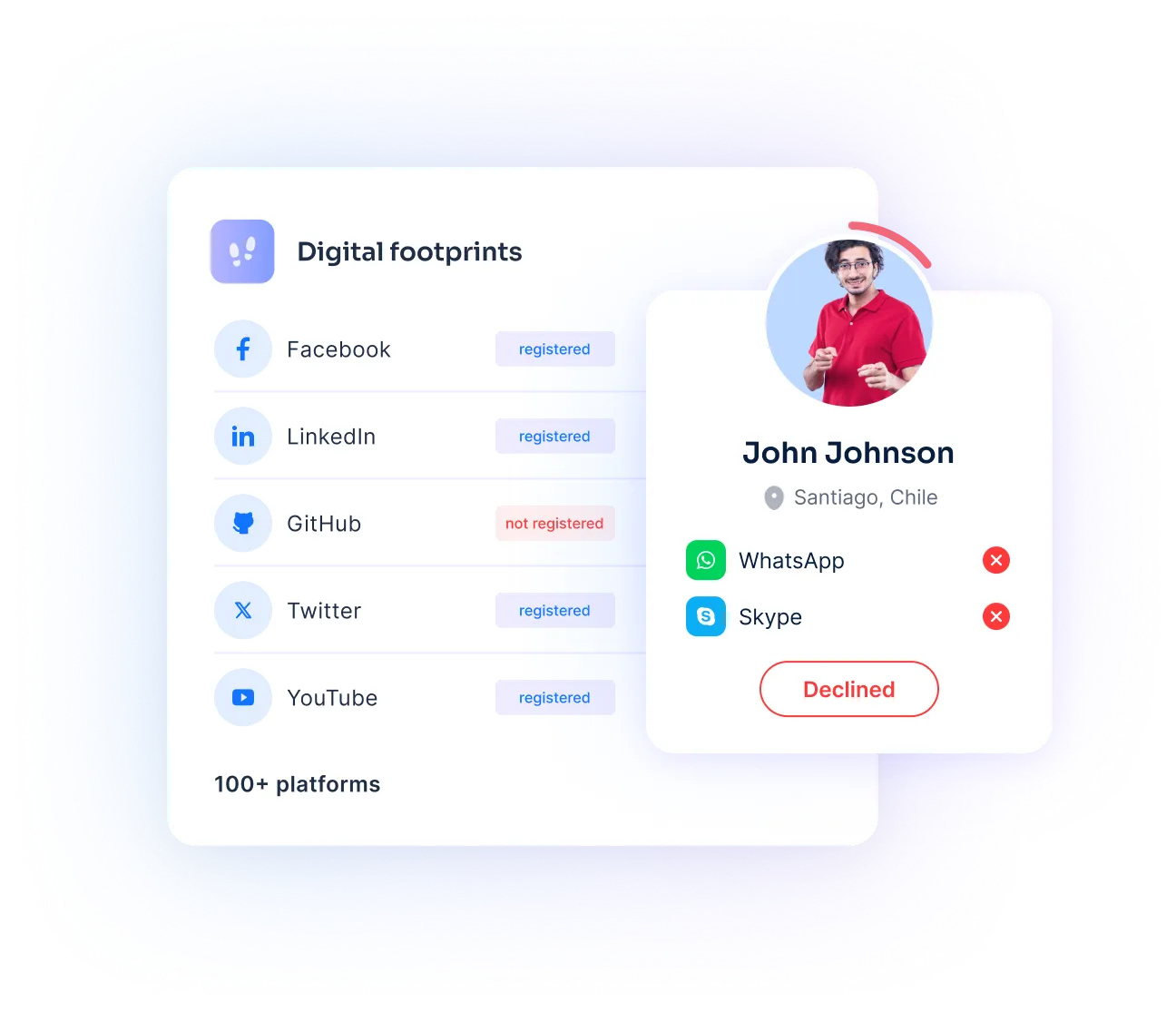
RiskSeal provides BNPL providers with digital footprint analysis that includes real-time verification of email, phone number, and IP address. Also, RiskSeal checks the applicant against 200+ platforms like social media, e-commerce and professional services, messengers, gambling websites, and more.
This helps BNPL providers assess credit risk and detect fraud by analyzing consumer behavior and online presence.
What extra data points does RiskSeal use to boost BNPL Digital Credit Scores?
To enhance BNPL Digital Credit Scores, RiskSeal incorporates additional data points including Full Name, Location, and Photo, providing a comprehensive view of a consumer's digital profile.
How does RiskSeal impact BNPL decisions with its Digital Credit Score?
RiskSeal's Digital Credit Score influences BNPL decisions by providing a predictive measure of a customer's likelihood to repay, derived from their digital footprint. This includes analysis of social profiles, professional and educational backgrounds, and lifestyle habits.
It enables BNPL providers to identify high-risk applications early, reducing reliance on KYC and bureau checks.
Furthermore, it bolsters Machine Learning models, improving the accuracy of credit scorecards.
How quickly can RiskSeal process transactions for BNPL services?
RiskSeal processes transactions for BNPL services in real-time, completing checks within 4 to 12 seconds based on the data complexity.
What is BNPL risk management software?
BNPL risk management software helps providers decide whether an applicant is likely to repay. It brings together credit, identity, fraud, and behavioral signals in one decision flow. The software helps teams assess applications quickly without relying only on traditional credit scores. It also flags cases that need a closer look. This matters because BNPL decisions often happen in seconds at checkout.
How does BNPL credit approval software work?
The process starts when the customer shares basic details, such as an email address and phone number. The software then checks available data sources and looks for useful risk signals. It analyses the applicant’s identity, digital history, device, and behavioral patterns. A risk score or decision is then calculated using the provider’s rules. Low-risk cases can be approved automatically, high-risk cases can be declined, and uncertain applications can go to manual review.
How can alternative data improve BNPL underwriting?
Alternative data gives lenders more context when bureau data is limited or outdated. It can reveal how established an applicant’s email, phone number, and online identity are. Local platform registrations, account activity, subscriptions, and digital behavior can also add useful signals. These insights help BNPL underwriting teams separate genuine customers from risky or low-intent applicants. They can also strengthen existing models with data that does not simply repeat bureau information.
What data is used for BNPL risk assessment?
BNPL risk assessment can use both traditional and alternative data. Common inputs include email details, phone data, IP information, and device signals. Providers may also review social presence, digital footprint depth, and registrations across online platforms. Behavioral indicators can show how consistent and established an applicant appears. The exact mix depends on the market, lending policy, and available data sources.
Can BNPL providers approve thin-file borrowers?
Yes, but they need enough reliable data to make a confident decision. Thin-file borrowers have little or no traditional credit history, which makes standard scoring less informative. Alternative data helps fill those gaps with identity, digital footprint, and behavioral signals. Risk teams can use this extra context to identify applicants who look stable despite limited bureau records. This can increase approvals while keeping risk controls and review thresholds in place.