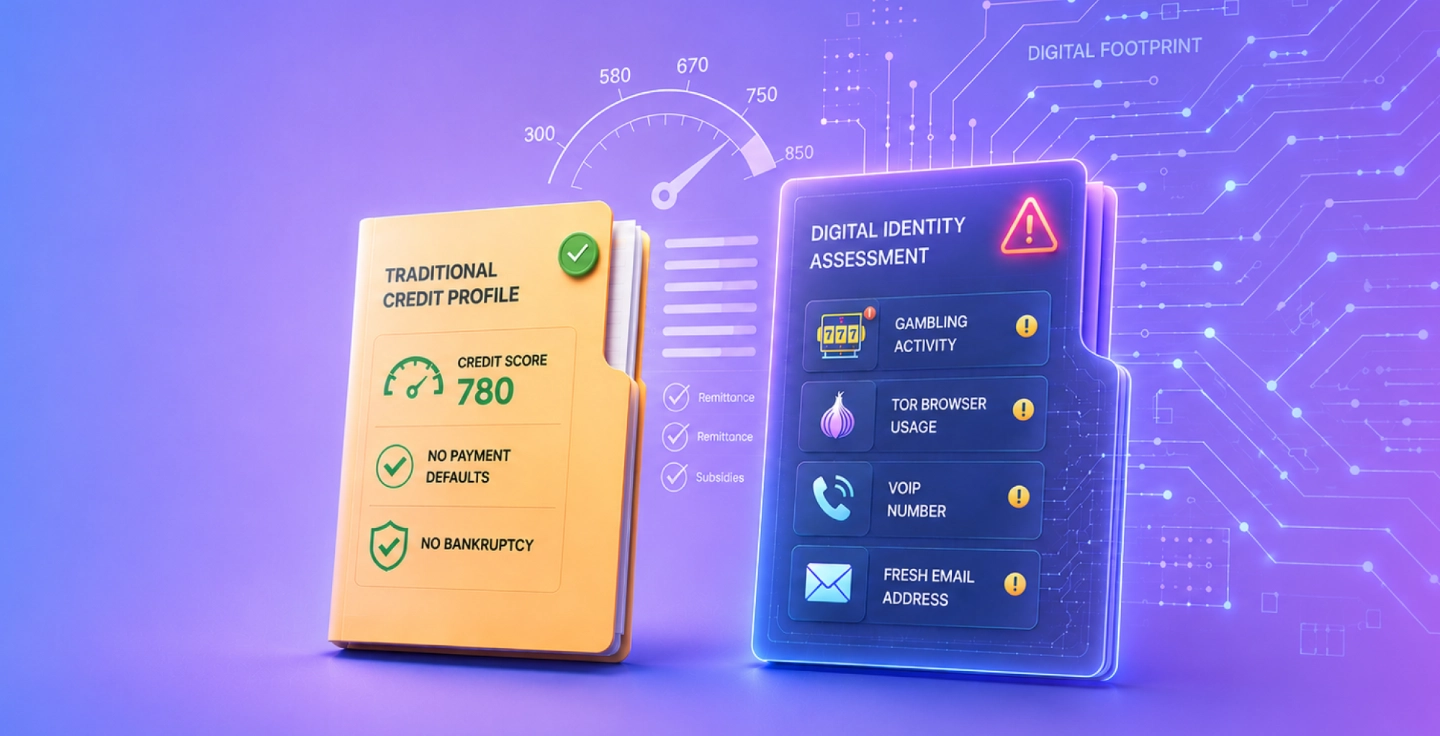
Compare two real thin-file borrowers and discover how digital signals help lenders make more confident credit decisions.
Two borrowers apply for the same loan. Their credit scores are nearly identical. Both have repaid previous debts on time. On paper, they look equally reliable.
Yet one may be approved immediately, while the other faces extra checks, a smaller limit, or rejection.
The difference lies in what the credit file cannot show.
Here's the question this article answers: When a credit bureau can't tell two thin-file borrowers apart, what else can a lender look at to make a confident decision?
Credit history is the natural place to begin assessing a borrower.
It remains the foundation of credit risk assessment. Credit bureaus were built to record formal financial behavior, and they do that job well.
The difficulty begins when an application falls into the gray zone. The borrower does not look clearly risky, but the available history is too limited to support a confident approval.
Credit bureaus were never designed to capture digital behavior.
Most credit reporting systems were created long before email accounts, smartphones, online subscriptions, and digital applications became part of everyday life.
That does not make bureau data outdated. It means the first step should not always be the only step.
When the traditional model cannot reach a clear decision, digital signals can add context that formal credit records were never intended to provide.
Let’s compare two applicants side by side. Both applied to the same lender for the same loan amount.
The profiles below are based on real borrowers, with identifying details removed or changed to protect their privacy.
At first glance, the differences seem minor. Neither profile immediately signals high risk.
Both are young, economically active, and asking to borrow $800. More importantly, both have thin credit files.
That means the lender has some information about their past borrowing, but not enough to form a complete picture.
Based on the application data alone, there is little reason to approve one immediately and treat the other with greater caution.
Both borrowers paid back what they owed. Neither has much borrowing history to judge them by.
A bureau-based model has little reason to treat them differently. Both have repaid their previous debts, have no outstanding balances, and fall within a similar estimated score range.
The lender’s bureau-only model reached an AUC of 0.69. That’s good predictive power, but it also leaves a substantial part of the risk picture unresolved.
The question is not whether the bureau data is useful. It clearly is. The question is what else the lender can examine when that data leads to nearly identical assessments.
Alternative data is not a softer or more subjective way to assess applicants. It is still statistical and mathematical, but it draws on signals that do not appear in a traditional credit file.
Those signals generally add context in two areas:
The next sections walk through the main signal categories one by one.
An email address doesn't predict repayment by itself. But it does show how long an identity has existed and how consistently it's been used.
What it can reveal: age, domain, whether it looks disposable, naming pattern, how many platforms it's tied to, and any breach history.
Borrower A's email tells a long, continuous story. Borrower B's brand-new address raises a question, not a verdict.
A new email isn't fraud. It only becomes meaningful next to other signals – phone, IP, location, behavior. Still, at this point, it provides a new layer of clarity to the overall risk profile.
Email history adds confidence. It doesn't make the decision on its own.
A phone number often works like a long-term identity anchor. Its history shows whether contact details look stable or recently assembled.
Relevant data: number age, carrier type, recent carrier switches, VoIP status, and messaging activity.
An old, stable number supports continuity. A new virtual number isn't automatically a red flag. Plenty of people switch SIMs or use eSIMs while traveling.
It's the pattern that matters, not one changed carrier.
This isn't about rewarding people for having social media. It's about checking whether one consistent identity shows up across the digital environment.
Checks include name consistency, account age, messaging registrations, profile photo similarity, and whether accounts point to the same person.
Consistency lowers uncertainty. Mismatches aren't automatically suspicious – nicknames, transliterations, and regional naming habits all create natural variation.
Context matters more than the raw mismatch count.
This layer checks whether the technical side of the application matches the applicant’s story.
Covers: IP geolocation, time-zone consistency, device used to submit the application, and VPN, proxy, or Tor use.
VPN use is not inherently risky. Alex may use NordVPN for privacy, travel, or remote work. His established device, consistent time zone, and minor location shift still support his application.
Maria also uses an established device, which adds continuity. However, Tor hides the connection’s real origin and shows only the exit node’s location.
Combined with the time-zone mismatch, this makes her application environment harder to verify.
Neither VPN nor Tor proves fraud. The key difference is how well the technical signals align with the applicant’s stated details.
This layer is not about how much someone spends. It looks at whether their digital activity appears established and consistent over time.
Covers: subscriptions, e-commerce history, repeat purchases, service registrations, and gambling platform activity.
Subscriptions and shopping history do not measure income. They show whether an identity has developed naturally through recurring activity over time.
The type of service matters less than the age, continuity, and broader context of the account.
No individual registration should determine a lending decision. One gambling or crypto account may be ordinary consumer behavior.
A recent cluster of hosting, payment, crypto, or gambling registrations, combined with limited purchase history and few repeat interactions, deserves closer review.
The bureau data leaves both applicants in roughly the same place. At this stage, both borrowers appear suitable for consideration.
The digital data changes that assessment.
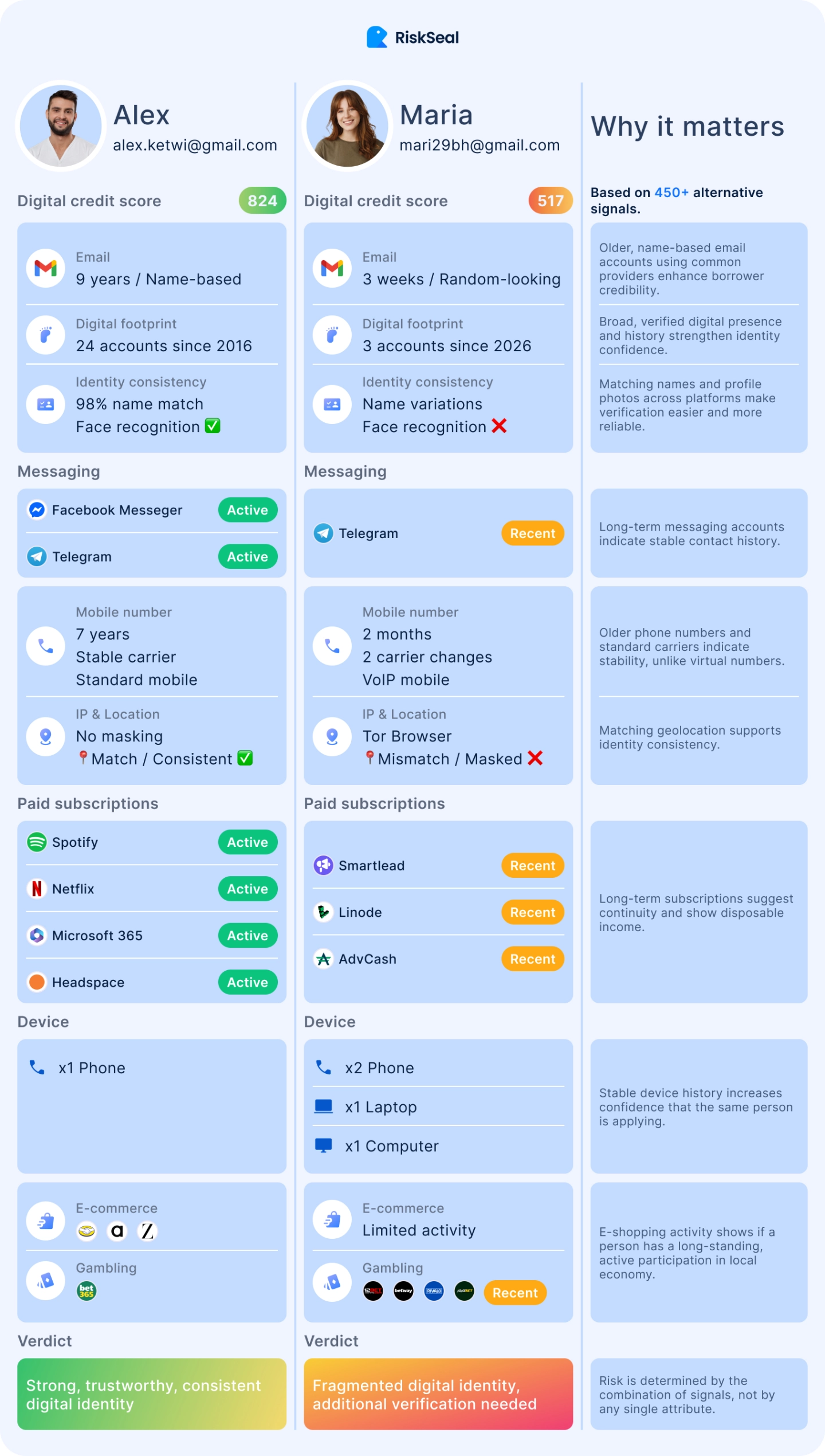
Alex Ketuwi’s signals reinforce the positive bureau record. His digital profile looks coherent.
That makes Mr. Ketuwi a strong candidate for approval. The lender could reasonably process the application with limited additional friction and may consider a higher level of automation.
Maria Navo presents a different case.
Her previous loans were repaid, but the current application is supported by:
None of these signals would justify a rejection on its own. Together, however, they create two concerns.
First, there is not enough established digital history to confirm the same level of borrower stability seen in Alex’s profile.
Second, the inconsistencies raise doubt about whether the application is genuinely being submitted by the person whose credit history appears in the file.
The practical decision is therefore no longer the same for both applicants.
Alex can be approved with high confidence. Maria should not pass through the standard approval path.
Depending on the lender’s policy, her application should be declined or moved to enhanced identity verification and manual review before any credit is issued.
The difference comes from testing whether the wider application supports it.
Finding useful digital signals is not a one-time data project. Lenders would need to:
Building and maintaining that enrichment layer in-house can quickly become a full-time operation.
This is where an alternative data provider like RiskSeal adds value.
Instead of asking the lender to assemble the infrastructure from scratch, RiskSeal delivers tested digital signals through a single API and fits them into the existing credit workflow.
Its main advantage is market-specific coverage.
Alongside global platforms, RiskSeal analyzes local services, marketplaces, telecom-related signals, and subscription ecosystems that reflect how people actually behave in a particular country.
These sources add information that does not simply repeat what is already available from a credit bureau.
The lender receives:
Before production, RiskSeal offers to test these signals against the lender’s own historical portfolio, for free.
This shows whether they improve Gini / AUC, strengthen segmentation, reduce defaults, or support more approvals without increasing portfolio risk.
Because the platform works as an enrichment layer, lenders do not need to replace their bureau model or rebuild the decisioning process.
They add another source of predictive evidence where the existing model has reached its limit.
We ran research across more than six million loan applications. The results were clear.
Digital signals carried real predictive value on their own. But the strongest results came from combining both data sources.
The result is easy to understand in practical terms. Bureau data shows how someone handled credit before.
Digital data shows who they are right now. Put together, they cover more of the picture than either one alone.
The bureau saw two applicants with similarly thin, positive histories. Digital identity analysis showed a real gap in how confidently each could be assessed.
Alternative data didn't erase either borrower's credit history. It didn't decide the outcome by itself either.
It gave the lender more to work with. Underwriting is ultimately about predicting who will repay, and how much uncertainty you're willing to carry.
The more complete the picture, the easier it gets to say yes to good borrowers without taking on risk you can't see coming.
Learn how to grow approvals with risk-adjusted acquisition, better funnel checks, and borrower quality metrics.


Compare RiskSeal and SEON digital scoring systems and choose the best option for your business goals.

Discover global lending trends that can shape credit scoring strategy for successful financial inclusion.