
Learn how Fraud as a Service is changing loan fraud and why traditional detection methods struggle to keep up.

Fraud as a Service refers to a commercialized fraud model where criminals sell ready-made tools to enable financial fraud.
In lending, fraudsters can now launch sophisticated attacks without tech skills by purchasing everything needed – fake identities, application scripts, and synthetic identity kits.
Just as SaaS providers offer software on subscription, FaaS providers sell fraud capabilities on demand.
This shift means lenders need equally scalable defenses, turning to fraud prevention as a service to protect their business models.
A FaaS provider is typically an organized group or network that develops fraud tools and sells access to them. These providers operate like businesses, complete with customer support and product updates.
Services offered include ready-made fraud scenarios tailored to specific lenders or product types. Buyers receive detailed scripts that outline application behavior, income documentation, and timing patterns designed to pass initial screening.
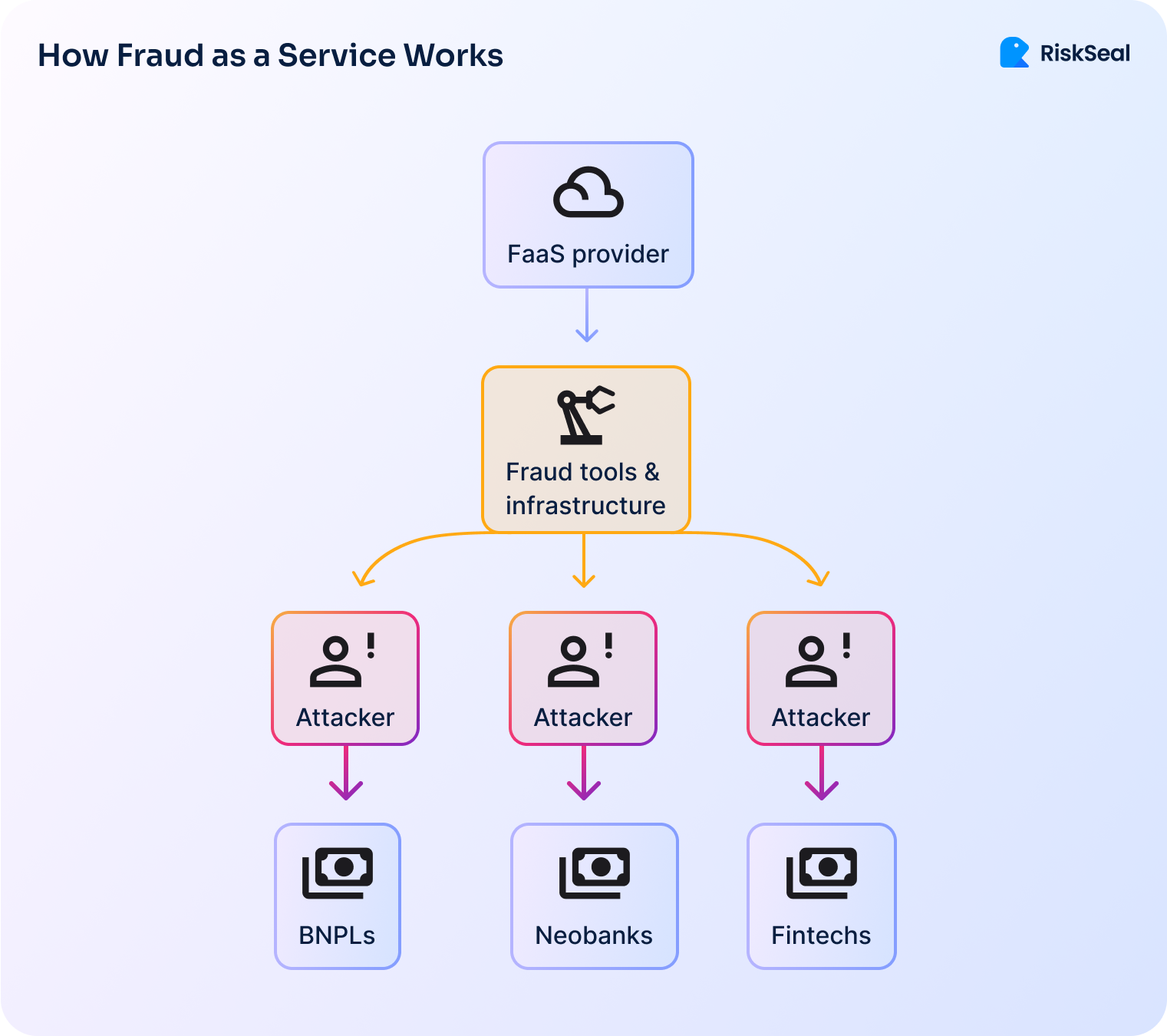
Infrastructure is another core offering.
This includes synthetic identities built from real and fabricated data that bypass identity theft protection services and aged accounts with transaction history. Providers often maintain inventory of these assets.
Technical support ensures buyers can execute successfully. Providers offer tutorials, troubleshooting assistance, and updates when lenders change their controls.
Some even guarantee results or offer refunds for failed attempts.
Payment models vary. Subscription plans grant ongoing access to tools and data. Pay-for-performance models charge based on successful loan disbursements.
Loss-sharing agreements split revenue between the supplier and buyer, aligning interests and reducing upfront costs.
FaaS providers specialize in fraud types that target lending and digital financial services specifically. The most common offerings include:
These fraud types share a common trait: they generate immediate financial gain with relatively low technical barriers to execution.
FaaS fundamentally changes the fraud landscape and complicates financial fraud prevention by eliminating the need for specialized knowledge.
Anyone with cash can now execute sophisticated attacks that previously required technical skill or insider access. This democratization floods the market with fraudsters.
The model makes fraud scalable in ways individual actors cannot achieve. A single provider can serve hundreds of buyers simultaneously, each targeting multiple lenders.
This creates volume that overwhelms traditional detection systems and dilutes fraud signals across portfolios. Lenders face an increase in high-quality fraud that mimics legitimate borrower behavior.
Applications arrive with proper documentation, consistent data, and behavior patterns that match approval criteria. Early default rates deteriorate as professionally engineered applications pass through decisioning.
Credit risk teams struggle to separate genuine high-risk borrowers from fraud identities. Both may present thin files or elevated risk indicators, but only one represents intentional theft.
This blurring forces lenders to either tighten policies and reject good customers or accept higher fraud losses.
Traditional fraud involves individual actors working alone or in small groups. Each case represents improvised attempts with unique characteristics.
Fraudsters test approaches, make mistakes, and leave detectable anomalies in their application data.
FaaS operates through organized networks that develop repeatable scenarios. These scenarios are tested, refined, and distributed at scale.
| Characteristic | Traditional fraud | Fraud-as-a-Service (FaaS) |
|---|---|---|
| How it’s built | On the fly, trial-and-error | Designed once, reused many times |
| Consistency across applications | Low, every attempt looks a bit different | High, applications look eerily similar |
| Learning curve | Fraudsters learn by failing | Networks learn before scaling |
| What traditional detection systems see | Spikes, mistakes, outliers | Clean, “expected” behavior |
| Risk over time | Contained, case-by-case | Compounding, portfolio-wide |
Each execution follows a proven template designed to avoid common detection triggers.
The behavior shift is significant. Individual fraudsters create anomalies that stand out in data. FaaS applications are engineered to appear normal.
They match expected patterns for income, employment, and spending. Detection systems looking for outliers miss them entirely.
FaaS uses valid data rather than fabricated information. Identities are built from real SSNs, addresses, and employment records. Documentation comes from legitimate sources or high-quality forgeries. Nothing in the application itself signals fraud.
Behavior remains consistent across the customer journey.
Application timing, device usage, and interaction patterns mirror genuine borrowers. Fraudsters follow scripts designed to match lender expectations at every touchpoint.
Fraud distribution compounds the problem.
Attacks spread across time periods and product lines, preventing concentration that would trigger alerts. Each application appears isolated rather than part of a coordinated campaign.
Rule-based approaches fail against this model. Rules identify deviations from normal behavior, but FaaS applications are designed to be normal. Traditional fraud scores miss what they're not trained to see.
Fraud detection software that uses alternative data and AI shows better results against FaaS. It can identify behavioral patterns and digital connections that rules-based systems overlook.
FaaS creates ambiguity in credit decisioning by blurring the line between high-risk borrowers and professionally engineered fraud identities.
Both may present elevated risk signals, thin credit files, or inconsistent employment history. Traditional credit scoring cannot distinguish between them.
This requires lenders to adopt link analysis that identifies connections between applications, devices, and identities.
Network-based risk signals reveal coordinated activity that individual application reviews miss. Cross-application visibility becomes essential for detecting patterns that span portfolios and platforms.
Fraud as a Service transforms fraud from isolated incidents into an industrialized process that scales across markets and products.
For lenders, FaaS is a structural risk factor that demands changes to decisioning architecture.
This often means integrating fraud detection as a service solutions that provide real-time network intelligence and cross-portfolio visibility. Understanding this threat is critical for building resilient credit systems.
