Explore the credit data sources US lenders use, what each reveals about borrowers, and how combining them can improve approvals and reduce losses.
Credit is part of everyday American life. From credit cards to car loans, millions of people rely on borrowing to manage expenses and make major purchases.
While borrowers worry about interest rates and monthly payments, your risk team faces different questions. Who should you approve? How much risk can you take? And how do you assess applicants with limited credit histories?
Traditional credit data remains essential to US lending. Yet consumer borrowing habits are changing, and digital lenders are introducing more flexible products and approval processes.
For your institution, staying competitive means finding ways to assess more applicants without exposing your portfolio to unnecessary risk. So, which credit risk data sources can help you achieve that?
Most American lenders start their credit assessments with three nationwide consumer reporting agencies:
These companies receive information from banks, credit unions, credit card issuers, and other creditors. Their reports show how consumers have managed existing financial obligations.
Lenders use this information to evaluate several aspects of credit risk:
However, lenders may receive different results from each bureau. Creditors don't always report to all three agencies.
Reporting schedules also vary. An account update may appear in one bureau's records before reaching another.
Credit reports contain the underlying information. Scoring models translate that information into estimates of credit risk.
Two major scoring providers operate in the US:
Both commonly use a 300-850 scoring range. However, different model versions can produce different results for the same consumer.
Lenders select scoring models according to their products and risk policies. Many also develop proprietary models using bureau attributes and internal performance data.
A credit score helps estimate the likelihood of future repayment problems. It doesn't independently establish whether someone can afford another loan.
According to the Federal Reserve, around 32 million US adults lack a conventional credit score. This includes 7 million credit-invisible consumers and 25 million with insufficient credit history to generate a score.
The potential customer base is also evolving. By 2024, the US foreign-born population had reached 50.2 million, while digital financial services continued to expand.
For your lending business, limited credit visibility creates a competitive challenge. Applicants with thin credit files may qualify for products offered by lenders using broader assessment methods.
Traditional credit reports also offer limited insight into recent income changes, spending patterns, and current financial pressure.
The challenge is finding additional information that helps you assess these applicants without increasing credit losses or compromising regulatory compliance.
Alongside Equifax, Experian, and TransUnion, US lenders can access reports from specialty consumer reporting agencies (CRAs).
Unlike nationwide credit bureaus, these companies focus on specific financial activities or consumer segments. They may track subprime loans, deposit account histories, rental payments, or other specialized records.
The Consumer Financial Protection Bureau (CFPB) maintains a list of these agencies. Several are particularly relevant to consumer lending.
Specialty agencies such as Clarity Services (owned by Experian), DataX (owned by Equifax), and FactorTrust collect information about subprime and short-term borrowing.
Their records may cover payday loans, installment loans, rent-to-own agreements, and other products with limited visibility in mainstream credit reports.
For lenders serving near-prime and subprime consumers, these reports can reveal additional repayment obligations, borrowing patterns, or previous delinquencies.
ChexSystems and Early Warning Services specialize in deposit account screening.
Their reports can include checking account closures, unpaid negative balances, and other account-related concerns.
Banks primarily use this information when opening accounts. Certain records may also support credit and identity risk assessments.
However, deposit account problems don't necessarily predict loan defaults. Their relevance depends on the lender's assessment model.
Other specialty agencies serve narrower markets.
For example, Innovis provides supplementary consumer reporting information, while the National Consumer Telecom & Utilities Exchange (NCTUE) collects telecommunications and utility account data.
Specialty reporting also extends into tenant screening, insurance, employment verification, and other industries.
Like nationwide credit bureaus, specialty CRAs are generally subject to the Fair Credit Reporting Act (FCRA), including requirements related to permissible use, accuracy, and consumer disputes.
For your risk team, these agencies offer access to specific records beyond conventional credit files. However, even combined, these reports may leave important questions about an applicant's current finances or other risk characteristics unanswered.
Credit bureaus and specialty CRAs provide established reporting channels. Alternative data expands the range of information your risk team can consider.
It includes cash-flow records, recurring payments, and digital activity. These sources help assess current financial circumstances and risk characteristics that conventional credit histories may not fully capture.
Depending on how the information is collected and supplied, alternative data may also fall under FCRA requirements.
Cash-flow analysis helps lenders understand how money moves through an applicant's accounts.
With appropriate authorization, financial data services can provide access to bank transactions and account information.
Lenders can analyze:
This information is useful when assessing repayment capacity.
Consider two applicants with identical credit scores and reported incomes.
One maintains positive monthly balances and predictable expenses. The other regularly spends more than they receive.
Their credit histories might appear similar. Their current financial circumstances suggest different affordability risks.
Research supports the value of this additional perspective.
In their CFPB article, Looking at credit scores only tells part of the story – cashflow data may tell another part, Alexei Alexandrov, Alyssa Brown, and Samyak Jain discuss this opportunity.
They explain how cash-flow data may reveal information missing from repayment histories. However, the authors also emphasize the need for further research.
Account access also has practical limitations. Applicants may hold multiple accounts or receive income outside traditional banking channels.
Employment verification helps lenders confirm information supplied during an application.
Data may come from employers, payroll systems, or authorized employment verification services.
These sources can confirm income amounts, payment frequency, and employment status.
For example, a personal loan applicant reports earning $5,000 monthly. Verified payroll records can help confirm that figure.
Some services also help assess borrowers with variable earnings. These include gig workers and applicants with multiple income sources.
Still, verified earnings represent only part of affordability.
A borrower may earn a substantial salary while carrying high monthly obligations. Lenders need other information to understand available repayment capacity.
Many Americans regularly pay rent, electricity, internet, and phone bills.
These payments can demonstrate financial responsibility outside conventional credit products.
Some services collect payment information from landlords, property managers, and utility providers. Others allow consumers to add eligible payments to their credit records.
For example, Experian offers Experian Boost, which lets consumers add certain eligible payments to their Experian credit file.
This can provide additional history for applicants with limited traditional credit activity.
However, reporting remains incomplete across providers and payment categories.
A missing record doesn't necessarily mean someone failed to pay. Lenders must also consider whether the data predicts future credit performance.
Buy now, pay later has introduced another source of consumer borrowing information.
BNPL providers collect records of purchases, installment schedules, outstanding balances, and repayments.
These records can reveal short-term financial commitments that conventional credit files may miss.
For example, an applicant could maintain several active BNPL plans. Their combined payment obligations might affect near-term affordability.
Credit bureaus and scoring developers are expanding their ability to handle BNPL information.
However, reporting and scoring practices remain inconsistent.
According to FICO's current consumer guidance, the three nationwide bureaus are not currently feeding reported BNPL accounts into FICO Score calculations.
Lenders therefore need to consider which BNPL records are actually available. They should also understand how their selected scoring models treat them.
People leave digital traces through everyday online activity.
They register email addresses, use messaging services, shop online, and maintain subscriptions. These activities can provide additional information during customer onboarding.
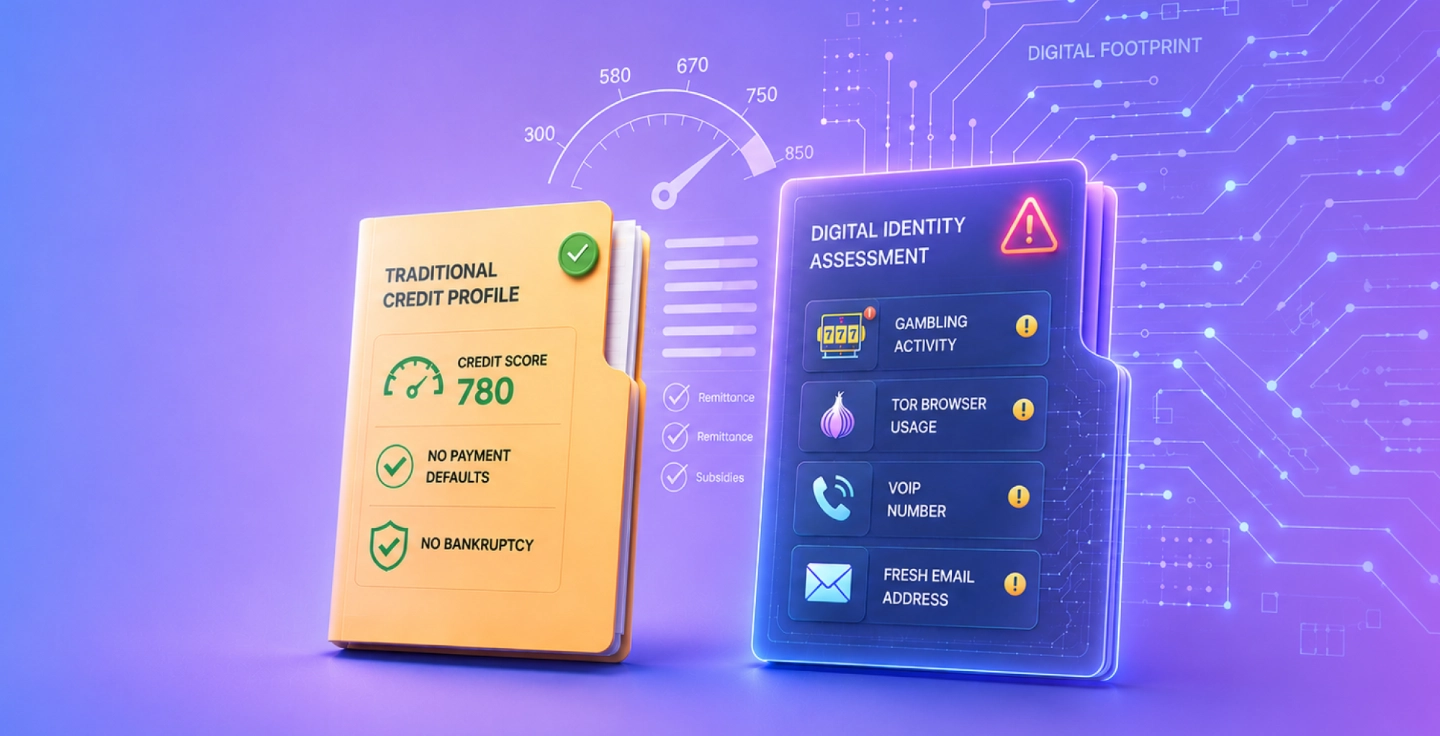
At RiskSeal, we build predictive credit data using these digital footprints.
Our technology analyzes information linked to applicants' email addresses, phone numbers, IP addresses, and other identity attributes.
Depending on availability, RiskSeal can generate up to 450 signals per applicant. These come from more than 200 global and local online sources.
Examples include:
These signals can support identity checks, fraud detection, and predictive risk assessment.
Imagine someone who recently moved to the United States.
They may have no established US credit history. Yet their email address has existed for years. They might also maintain consistent contact information and active accounts across online services.
These details provide additional context for the lender's assessment.
Of course, limited online activity doesn't establish that someone is risky. A single missing account or subscription should never determine creditworthiness.
What matters is the predictive value of relevant signals together.
Digital footprint analysis also has clear boundaries. It cannot directly verify income or calculate disposable earnings.
Its greatest value comes when it contributes information beyond the lender's existing sources.
Different credit data sources help your risk team assess repayment history, affordability, and applicant risk.
The table compares their applications, limitations, and examples of providers serving the US market.
Three questions emerge from this comparison.
Has the applicant repaid credit responsibly before? Traditional credit records provide the strongest direct evidence.
Can the applicant manage another financial obligation? Cash-flow, income, and existing debt information help answer this.
Does the available information support a reliable risk assessment? Specialty records and digital intelligence can provide additional evidence.
These questions often require more than one data source.
Choosing a credit data provider involves more than comparing available information. Your risk team needs to understand how each provider supports your lending products, customers, and underwriting process.
Consider these six criteria before making a decision:
The right choice depends on the gaps in your current assessment process. Once you identify those gaps, you can determine which providers and data sources work best together.
There is no universal underwriting formula across American consumer lending. Institutions select data according to their products, customers, and risk appetite.
Traditional banks and credit unions often place considerable weight on bureau information. They may combine it with internal customer records and income verification.
Additional data can help evaluate borderline applications or support specific lending programs.
Digital lenders and neobanks frequently rely on automated onboarding and scoring. Cash-flow information, alternative risk attributes, and identity intelligence can support these workflows.
BNPL providers face particular demands around speed and transaction-level risk. They may combine internal repayment history, bureau information, affordability checks, and fraud signals.
A lender's strategy also depends on its existing customer relationships.
For example, a bank already serving an applicant may have years of account activity. A new digital lender might need external data to reach a comparable level of understanding.
Imagine a first-time credit card applicant with limited bureau history.
Their application passes initial eligibility checks. However, the credit file offers insufficient evidence for a confident decision. That’s when additional sources of information comes into play:
The resulting decision might involve approval, rejection, adjusted terms, or manual review.
Each institution decides which data deserves weight in its model. That decision should reflect testing, regulatory requirements, and observed portfolio outcomes.
I've seen the value of additional credit data through RiskSeal's work with Neu Money.
The US credit card provider serves students, recent graduates, immigrants, and first-time cardholders.
Many applicants have limited conventional credit records. Neu needed additional information without introducing more onboarding friction.
The company integrated RiskSeal's Digital Credit Scoring API into its existing assessment process.
Historical backtesting helped validate the additional signals before implementation.
The case study reports three results:
The example shows how supplementary data can help lenders evaluate applicants with limited credit history.
It also illustrates why additional predictive information matters commercially. Better risk differentiation can support both portfolio growth and loss control.
Access to more data doesn't automatically lead to better credit decisions. In fact, adding new sources without a clear purpose can increase costs and complexity without improving portfolio performance.
Before investing in another data provider, consider where your current underwriting process struggles. Which applicants are you unable to assess confidently? Where do manual reviews slow down approvals? And which additional signals could genuinely change a lending decision?
Your competitors may have access to the same credit bureaus, scoring models, and data providers. The difference lies in how effectively you use that information.
Ultimately, your competitive advantage depends on how well you turn available data into profitable, responsible lending decisions.

Credit scores may differ because Equifax, Experian, and TransUnion don't always receive the same information from creditors. Reporting schedules also vary, meaning recent payments or account changes may appear in one bureau's records before another. Additionally, lenders may use different scoring models or model versions, which can produce different results for the same applicant.
Lenders can assess businesses with limited or no credit history using alternative financial information. This may include bank transactions, cash-flow patterns, revenue consistency, and verified business income. They may also consider the owner's personal credit history, business operating history, and existing financial obligations to estimate repayment risk.
Lenders should assess applicant coverage, data accuracy, freshness, and relevance to their target customers. They should also review compliance practices, data sourcing methods, and integration options, including API availability. Most importantly, providers should demonstrate how their data improves credit risk assessment, ideally through measurable predictive performance and portfolio-level testing.

Discover what really drives loan approval decisions and how alternative data helps lenders make the most of acquisition costs without increasing risk.


Explore how to check a digital footprint and learn what online signals can reveal to lenders during credit risk assessment.
Compare two real thin-file borrowers and discover how digital signals help lenders make more confident credit decisions.