Learn five different methods on how to discover the age of an email account.

Email accounts have become one of the most common digital identifiers. Whether it’s Gmail, Outlook, Hotmail, Yahoo Mail, or another provider, email is used to create accounts, verify identity, and access online services.
According to PGM Solutions, the number of global email users is expected to reach 4.73 billion by 2026. This makes email age a valuable signal for understanding user behavior and assessing potential risk.
In this article, we explore how email age can be estimated, why it matters for risk assessment, and how businesses use this signal to detect fraud and evaluate digital identities.
| Approach | Core goal |
|---|---|
| Domain registration date | Establish the earliest possible email creation date from the domain’s age. |
| Social media or online services | Estimate email age using the earliest activity on linked accounts. |
| Analysis of breached data | Confirm the email existed by the date of its earliest known breach. |
| Cross-referencing with other information | Improve accuracy by validating the estimated age across multiple sources. |
| Cross-referencing with other information | Find the email’s earliest publicly indexed online appearance. |
Approach #2
If it's a custom domain email (like name@company.com), you can check the domain's registration date using WHOIS databases.
This won't tell you when the email address was created, but it can give you the earliest possible date since the email couldn't have been created before the domain was registered.
In the image below, you'll find a snapshot of the riskseal.io domain details, highlighting the creation date: September 28, 2022.

A social account search by email can help identify online profiles and services associated with a particular email address. People often use their email addresses to register for social networks and other digital platforms.
If the email is connected to such accounts, the date of the earliest activity on these platforms might provide a clue.
In the screenshot below, we can see that the Intro section of a Facebook user indicates that the date of their registration in the social network is January 2010. Therefore, we have reason to believe that the e-mail with which they registered on Facebook was created no later than January 2010.

Two important points should be noted:
Understanding how lenders use email breach data starts with recognizing what this information can reveal about an email address’s history. A data breach occurs when information is accessed or taken from a system without the owner’s knowledge or authorization. Public services collect records from known breaches and allow users to check whether an email address appears in them.
If an email is found in a breach database, it was likely active when that breach occurred. The date of the earliest record can therefore help establish the earliest confirmed point at which the email address was in use.
This information is available through services such as HaveIBeenPwned.com. RiskSeal’s email lookup service also provides data breach analytics, helping lenders assess an email address’s history as part of a broader applicant evaluation.

If you also have access to other pieces of information about the email account (like previous interactions or social media sign-ups), you can cross-reference these with the breach data to get a more accurate picture of the account's age.
This is an additional check that increases the chances of finding the correct email address creation date.
However, it's important to note that there is no absolute guarantee of success in this regard either.
with RiskSeal's email lookup
Google Dorking is a method for uncovering information on public servers through search engines. To find the creation date of an email using Google Dorking, you can use various search operators.
It's crucial to remember that the use of Google Dorking should comply with laws and ethical standards and should not compromise the privacy or security of other users.
While the exact creation date of an email account is rarely publicly available, specialized tools can estimate its age using signals such as domain history, breach records, and digital footprint data.
RiskSeal is an alternative data platform designed specifically for credit risk assessment. Instead of relying on a single signal, it evaluates an email address within the broader digital footprint of the applicant.
This approach allows lenders to estimate the maturity of an email address while also understanding the context behind it. This is essential for accurate credit decisioning.
Unlike generic email validation tools, RiskSeal was built for digital lending and fintech risk models. It delivers localized insights and regional data signals that are often unavailable in global lookup services.
Top functions
Price
Best for
IPQualityScore provides an email validation API widely used for fraud detection and identity verification.
It evaluates email reputation, detects disposable addresses, and identifies suspicious registration patterns.
Top functions
Price
Best for
Agemin focuses specifically on estimating the age of email accounts by analyzing public records, digital traces, and historical signals tied to an address.
Top functions
Price
Best for
Hunter.io is primarily an email discovery and verification platform used in sales and outreach workflows.
While it is not designed specifically for fraud prevention, it provides domain and verification data that can indirectly help assess email legitimacy.
Top functions
Price
Best for
AtData is an email intelligence platform used by enterprises to improve customer data quality and reduce fraud risks. It analyzes email reputation, activity signals, and engagement indicators.
Top functions
Price
Best for
Choosing the right tool depends on how email age is used inside your alternative credit scoring system. Some services specialize in deliverability and verification, while others focus on fraud detection or credit risk modeling.
In many cases, the strongest results come from platforms that evaluate email age alongside broader identity and behavioral signals.
The age of an email account is a valuable type of alternative credit data. It can help enhance risk management in lending organizations.

Recently created email addresses can serve as red flags for online lenders, while older accounts with a history can significantly increase a borrower’s chances of obtaining a loan.
Here is how lenders can utilize this information:
1. Risk assessment. Based on the results of an email address check, lenders can adjust their credit scoring processes. For example, it may be reasonable to scrutinize an applicant with a newly created email address more closely.
2. Borrower identity verification. Older email accounts are more likely to belong to legitimate users. This is because digital traces, such as profiles registered with the email or data leaks, are almost impossible to fake.
3. Detection of potential fraudsters. Criminals often use disposable email addresses to carry out fraudulent schemes. This allows them to hide their true identity and avoid accountability.
4. Pre-KYC checks. Utilizing an advanced email lookup solution enables lenders to filter out unreliable borrowers even at the application stage. This helps save costs on conducting Know Your Customer procedures for such applicants.

5. Enhancing user experience. Email address checks are rapid processes. They enable lenders to deliver credit application results in just a few minutes. Thus, borrowers don’t have to wait weeks for a decision. This improves the user experience and increases customer loyalty to lending organizations.
While email age cannot prove identity on its own, it helps companies identify suspicious patterns before deeper verification checks are triggered. Below are some of the main ways businesses use it.
Email age helps detect suspicious patterns during the earliest stage of registration.
Organizations may:
However, applicants should not be penalized simply for having a new email address. Legitimate users create new inboxes all the time. Context is essential.
For this reason, email age typically works as one feature inside a broader risk architecture, combined with signals such as:
Together, these signals help distinguish genuine users from synthetic identities.
Email age also contributes to risk-based onboarding strategies.
When systems detect a low-risk combination of signals, applicants can pass through frictionless registration flows with minimal verification.
Higher-risk combinations, like a newly created email combined with suspicious IP activity, may trigger additional checks such as:
The goal is proportional friction, not blanket restrictions. Legitimate users experience faster onboarding, while suspicious registrations receive deeper scrutiny.
Another major benefit of email age analysis is cost efficiency.
Verification processes such as KYC, identity document checks, and manual review are expensive. By identifying high-risk signals earlier, companies can:
This improves the overall unit economics of digital onboarding, particularly for fintech platforms that process large volumes of applications.
When integrated into scoring models, email age becomes a powerful signal for separating legitimate users from high-risk registrations.

We analyzed 6.1 million loan applications
The results show how digital credit scores correlate with default risk.
Fraudsters know lenders flag newly created email accounts, so they’ve adjusted their playbook.
Instead of relying on obvious throwaway inboxes, they now manufacture aged-looking identities designed to pass basic verification.
This makes email age useful only when interpreted alongside the broader digital footprint. Effective financial fraud prevention with digital footprints involves comparing email age with device, network, identity, and behavioral signals to reveal inconsistencies that basic checks may miss.
A lender must be able to separate the appearance of maturity from the reality of behavior. That means evaluating email age within context, not as a single deterministic signal.
Credential breaches give attackers access to real inboxes that have been active for years. On the surface, these accounts look perfectly legitimate, which is why age alone can be misleading.
The indicators of takeover show up elsewhere:
A healthy account has rhythm. A compromised one doesn’t.
Fraud marketplaces sell older accounts with fabricated activity histories. Fraudsters then run automated warm-up scripts to imitate real usage and create the illusion of stability.
These accounts typically collapse under deeper inspection.
There is no matching phone or identity history, no cross-platform life, and no behavioral cohesion across systems.
The email is old, but the identity supporting it is hollow.
Some attackers embed themselves into legitimate conversations or recreate old message threads to mimic continuity.
This tactic works well against human reviewers, especially in high-volume queues.
Digital footprint analysis exposes the disconnect. The thread can look consistent, but the supporting signals, such as login routes and usage patterns, move abruptly in ways real users don’t.
Even when an inbox carries years of apparent history, the surrounding ecosystem tells the real story.
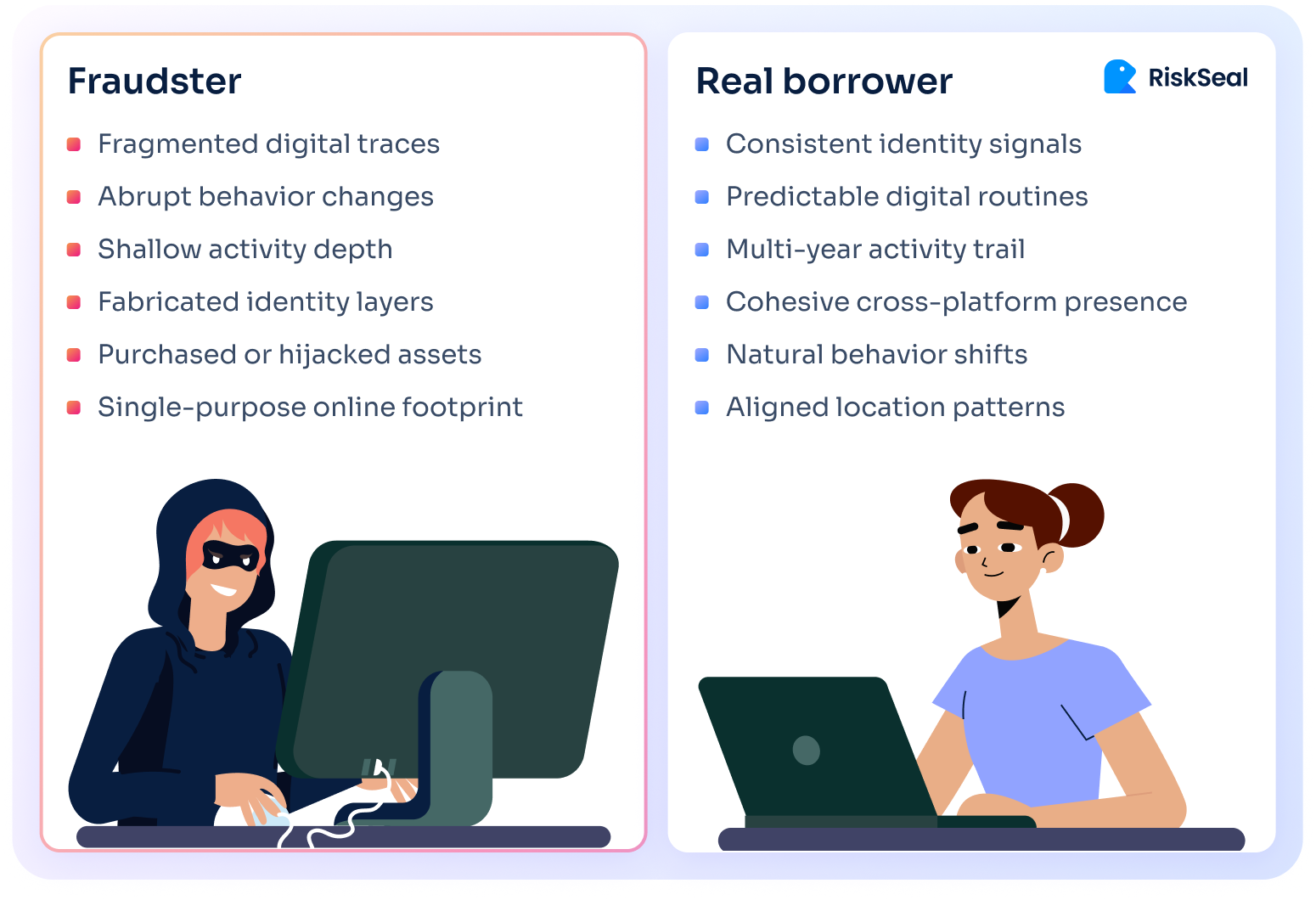
Genuine digital identities evolve gradually and consistently, with signals that reinforce each other over time. Several patterns tend to align in legitimate cases:
These signals develop over years, not weeks. And they tend to move in parallel, even when people relocate, switch devices, or travel frequently.
Synthetic or manipulated identities break that coherence. The email may look mature, but the broader footprint shows abrupt changes, shallow activity depth, or incompatible behaviors.
Fraudsters can buy an old inbox. But they cannot recreate the timeline that makes an identity authentic.
Innovative email lookup tools provide lenders with access to a wide range of applicant data.

At RiskSeal, knowing only the borrower’s email address, we provide our clients with the following information:

For more details about the role of email address checks in credit risk management, refer to our previous article "How email analysis helps lenders reduce risk".
Determining the age of an email account can be a complex process. Methods such as analyzing public data sources or examining breach records can provide useful insights, but they may lack precision when used independently.
RiskSeal’s email lookup for lenders combines multiple signals to provide a more comprehensive assessment of a potential borrower’s email address, including:

As a result, our clients receive over 450 data points and can assess the authenticity of the email address. This is made possible, in part, by data on its age and registrations across more than 200 social and online platforms.
Feel free to contact us for additional details on locating digital footprints.
We analyzed 6.1 million loan applications
The results show how digital credit scores correlate with default risk.

How reliable is the domain registration date in estimating the email account's age?

The domain registration date serves as the earliest possible date for the email account creation. However, it doesn't pinpoint the exact email account creation date. Keep in mind that the email could have been created after the domain registration date.
Can social media activity be a definitive indicator of an email account's age?
Social media registration dates can provide clues about the email's creation date. However, changes to email addresses on social media accounts and difficulty in verifying the linked email pose challenges. It's a useful hint, but not foolproof.
How accurate is the information obtained from data breach analysis?
If an email appears in a data breach database, it suggests the email was active during the breach. This gives the earliest possible date for the account's creation.
.webp)
Dive into explainable AI in credit scoring to boost transparency, reduce bias, build trust, and ensure full regulatory compliance.

.webp)
Explore 10 benefits of AI in credit scoring for lenders, including stronger risk differentiation, faster assessments, fraud detection, and thin-file coverage.

Learn how lending organizations can use social media lookup to increase the effectiveness of credit risk management.

.svg)